102: Other strange markings at the entrance to Victoria Cave, modern or not? 16/05/2026
Written and published by Linden Alexander Pentecost, published on the 16th of May 2026, this article is unrelated to and separate from any and all of my other publications, including those about other apotropaic markings at this site. This article was published only on this UK website, and was published in the UK and I the author am from and live in the UK. The two photos in this article were also taken by the author. No AI was used in this article nor in any of my written works. This article contains a total of 975 words.
Victoria Cave is a famous cave in Yorkshire, which I have discussed elsewhere in detail with regard to its history and possible apotropaic markings in the cave and at nearby caves, although I think it unlikely now that the markings within Victoria Cave itself are likely to be apotropaic, simply because of the modern excavation and graffiti since the excavations in the 1800s; and because it is difficult to say if any of the markings in the cave are truly older than that. Having said this, my older work on markings in the cave specifically is still important and relevant and does tell us a lot about the history of markings at this site, even if none of them may be likely to be of older origin.
Nevertheless though, Victoria Cave never seems to have been “entirely” closed, and was discovered when a dog found its way into the cave through an entrance mainly obscured by fallen rocks or scree. People also used the site in the Roman period. So it is not entirely impossible that people could have gone into the cave after the Roman period but before the 1800s.
Furthermore, some of the markings in the cave are similar to apotropaic markings. Sometimes it is also difficult to tell whether or not certain areas of the cave just show certain common erosion marks from water, or if actually certain areas of the cave might be covered in unnatural scratch marks. There isn’t really a lot of studies about these markings to be able to say a great deal about just how extensive they were, in most cases.
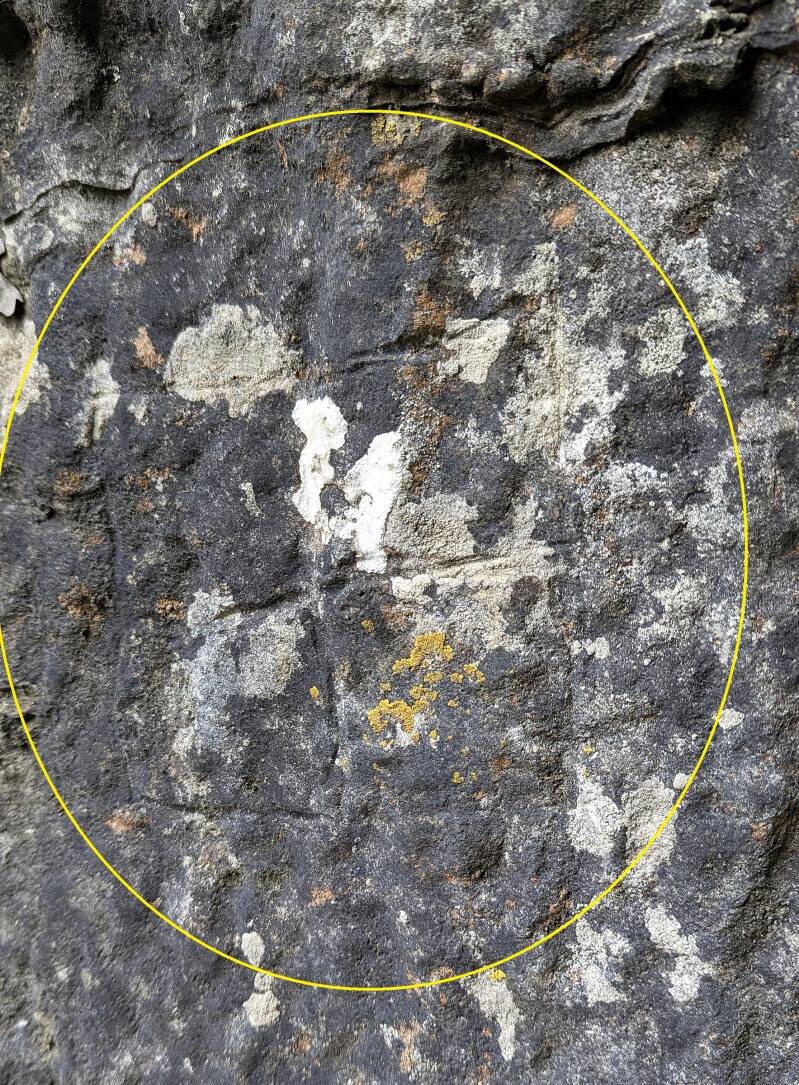
Furthermore, around the entrance to Victoria Cave, I did notice two very specific markings on my last visit there, which I did not notice beforehand. Now, it is entirely possible that these markings are not that old, because they are on an area of wall, to the left side of the entrance, just before one goes into the cave proper, which has been extensively altered since excavations at the cave began. So if these markings are old, then at least the lower one would have been completely obscured before proper excavations at the cave began.
The lower marking is interesting, consisting of a box with a cross inside it. This is really interesting because I have come across numerous other apotropaic markings that are similar to this, at other sites, plus Tom Lord mentioned to me a box with a cross in apotropaic marking at another nearby cave, which I have not yet visited. I have also photographed some other examples of these box-type apotropaic markings on several occasions, and have published about different examples of them. So this is interesting given the presence of such a marking at Victoria Cave. Is it artistic? Was it a continuation of apotropaic magic in some form into the 1800s, or more recently, and was carved there because of that? Or, could it be older? I personally think that the second possibility is most likely, but I just don’t know. Nevertheless, like other markings in this cave and at nearby caves, I think it is important to document it.
Photo below: the box-shaped carving, with a cross shape filling it, located on one of the walls just before one truly enters Victoria Cave, this carving being to the left.
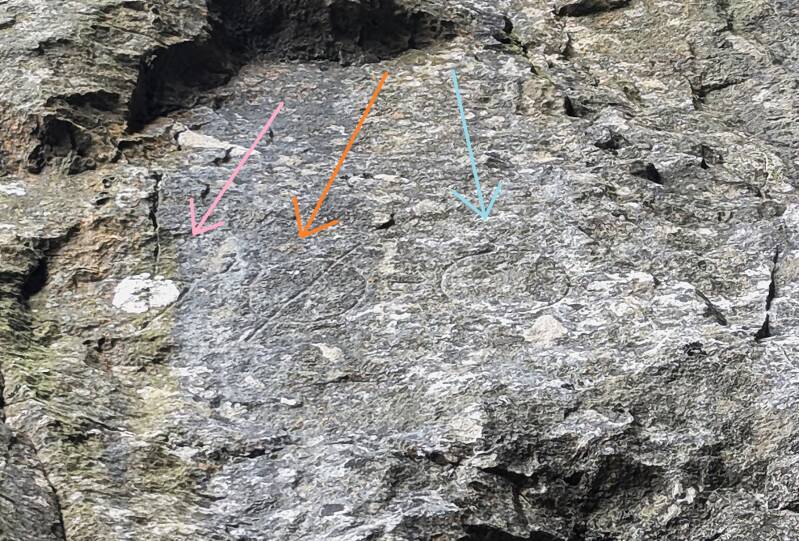
The other carving which I found possibility in association with the aforementioned, also in the photo above, is a carving of two circles, and one with a line through, possibly with other lines visible nearby. This reminds me a little of the Pictish double disk and Z-rod symbol. Could this be a form of modern apotropaic marking, even if for artistic purposes, based upon the Pictish double disk and Z-rods; or, again, could it be something else, or could it be something older? This marking is not possible to stand right next to, and to climb any closer to it is dangerous, but it can nevertheless be seen and photographed from around the same location where the box with cross symbol is located, but the double circle symbol is higher up on the wall and one has to look up at quite a steep angle in order to see it, unless one is like 15 foot tall that is - which, if you believe all the things about giants living in North Yorkshire in the past, might have been something that happened once. But anyway, the symbol in question can be seen in the photo below:
Photo below: the symbol consisting of two circles or disks next to each other, that to the left having a line through it from upper right to lower left, and extending beyond that circle on both sides; to the left of which is what looks like another symbol. The three parts of the symbol or individual symbols are pointed to with pink, orange and blue arrows, respectively, when going left to right.
I hope that this article was interesting. I will be writing and publishing more about other new apotropaic or other markings in the near future, this article is dedicated to my family and to the ancient spiritual guardians of Yorkshire.