90: More miscellaneous mythology discussions, also published on the 12/01/2026
Written and published by Linden Alexander Pentecost, published on this website, in the UK. This article was published on the 12th of January 2026. No AI was used in writing this article, except for the artwork included being AI-art, which has also been edited, showing a two-headed giant woman. This article is unrelated to and separate from all my other publications. I also published an unrelated article today on a different website. This article contains 1 photo and a total of 1341 words. The photo is located below the first of three written sections, and before the second section. The AI art was prompted, generated and edited by the author. Note I have also published many unrelated publications on other aspects of giants, or things that connect to giants, recently, and longer ago, including a publication published yesterday on a different website to this, which related to giants, and many more publications recently. The text above the image in this article contains information not in the main text, the image has also not been published before now, neither has this article of course.
On giants and trolls with more than one head:
Occasionally, the giant mythology of Britain and elsewhere, makes reference to the existence or idea of there being two-headed giants. The most famous example of such a giant in physical form is the mummified giant known as Kap-Dwa. The mummy is generally dismissed as a hoax, but it hasn’t to my knowledge ever been fully tested. Whilst the mummy is said to come from Patagonia, but during the 19th century, the mummy was taken around the world, including to England. Kap-Dwa, meaning “two heads”, is over 12 and a half feet tall. The giant known as Thunderdell, from British folklore, was sometimes described as having two heads.
In the folklore of Norway, trolls are often described as having more than one head. It is noteworthy that in Danish, the kraken was sometimes referred to as ankertroldet or “the anchor troll”, which may suggest a relationship between trolls, the kraken, and the idea of having several heads, especially given that the kraken, and for example Iku-Turso in Finnish mythology, are both described as many-headed, as well as being many-tentacled. If, hypothetically, two headed giant humans existed, like Kap-Dwa, would their nervous system and minds then be structured in some way more akin to a kraken? It is noteworthy that cephelopods also have several brains, that function together as individual parts of a whole. This is different from siamese twins for instance, and perhaps Kap-Dwa was not siamese twins, but rather one individual with two brains, with the individual spirit’s thinking processes happening in two brains, independent but connected, rather than one brain. Another aspect of these crossovers between giants and sealife and sea mythology are also discussed later into this article. It is also interesting I think that there are alchemical depictions of an adult with one female head and one male head, which seems to have been some kind of divine figure within alchemy, and perhaps representative of one's gender's "other", i.e. the inner "twin flame", being integrated into the psyche. As I have commented elsewhere with regard to Uyulala, and will continue on here - the idea of a consciousness being united, but separate in two forms, is also interesting in terms of how their languages would be, hypothetically. I have discussed much on the Uyulala aspects of this in other publications, and have discussed different aspects of it, including with cephelopods etc, in other publications.
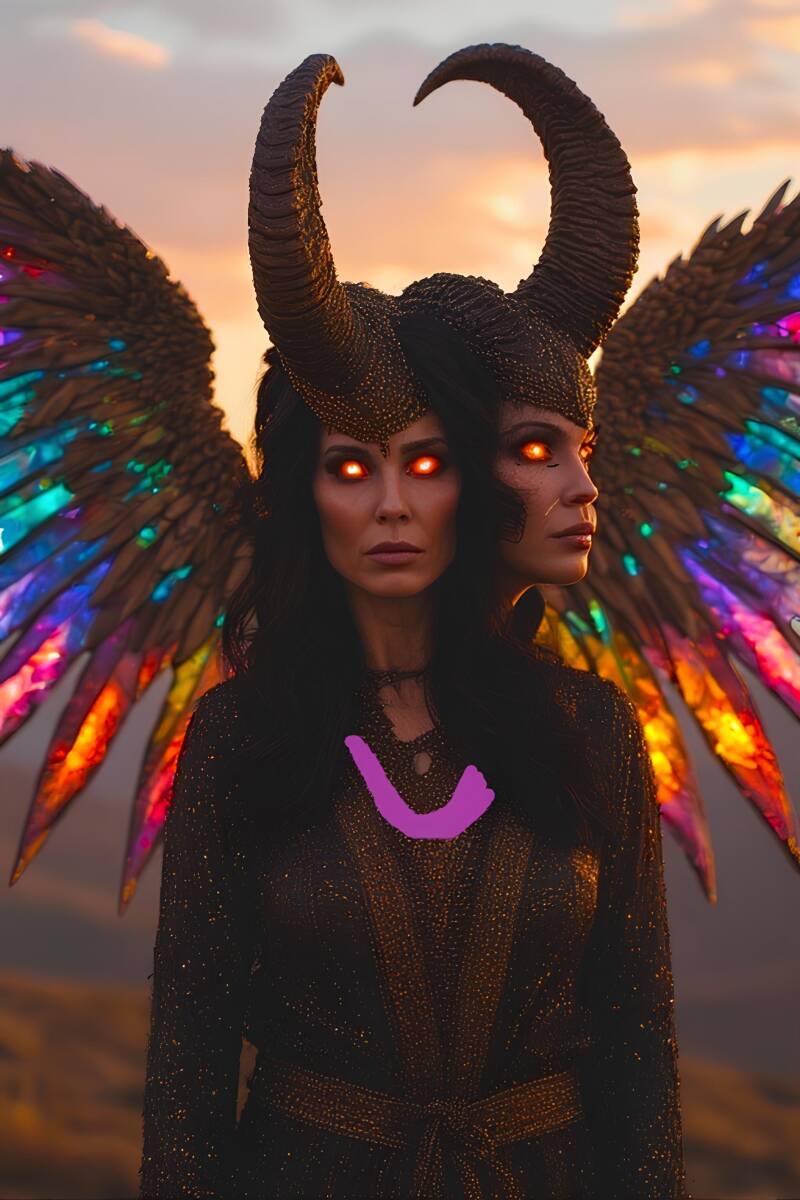
Photo below: an AI depiction generated by the author, of a giant adult woman with two woman heads instead of one, like most women. The horns and wings are supposed to invoke something of the metaphysical and angelic way in which these spirits are often described, particularly when we connect them with the idea of them having come from angelic beings, whilst also having for example, horns, associated with the mind.
On the relationship between serpents/wyrms, trees and fungus:
I have noticed recently that certain manifestations of wyrms/serpents in mythology, seem to associate them with certain trees. I have come across this and discussed it before without really seeing the connection. I once had a dream of meeting a dragon, in a dragon tree (I have described this in other publications). In parts of northwest England, a kind of worm is known to have lived in trees and flown in them (I have discussed these elsewhere including other comments recently in another publication). In Sweden, the lindorm is thought to have laid eggs in lime trees, and in some cases there is an implication that the worm lives in these trees. Another example I have come across recently is in the book, titled: Hollow Places An unusual history of land and legend, by Christopher Hadley. Whilst I have only just started reading the aforementioned book, one of the main points within it is the story of a dragon being concealed by an ancient yew tree. I wonder - what is the nature of this connection between dragons/wyrms and certain trees? In Icelandic mythology, the Níðhöggur worm is also known to gnaw at the roots of Yggdrasil, the Great Ash Tree.
I personally think that this relationship has something to do with trees being symbols and fractals of the cosmic tree, a means by which, in terms of animism, a spirit or soul can move between different realities or realms. So in terms of trees and wyrms, the wyrms are perhaps using trees to move between the underworld and this world. I also think that this relationship could have to do with the fungal networks that exist beneath, and connect trees. Wyrms, like fungus, are often associated with decay and with the renewal of life. Also, take for example the way that we use the word “worm” in the noun “ringworm” when referring to a kind of fungus in the skin. Whilst wyrms in mythology are often connected with being the cause of some diseases, the mythology also indicates that they have the ability to heal them. Our relationship with the greater concept of “wyrms” is a complex one. I have discussed other aspects of wyrms and serpent-like beings in other unrelated publications recently, including a few days ago on a different website.
Nuraghes, brochs and the shellfish diet of “giants”:
As I have mentioned elsewhere, the broch sites in Scotland are sometimes associated with giant ancestor beings known as ciuthaich. These ciuthaich have a clear association with the sea, and several broch towers in Scotland also show evidence of large consumption of shellfish. In North America, when the discovery of ancient giant skeletons has been reported in the past - the giants are often found alongside ornaments and other items made from aquatic resources, including a large usage of seashells. The island of Sardinia also has broch-like towers, known as nuraghes, which are often associated with giants, with some connecting this to the possible discovery of ancient giant skeletons on Sardinia. The Nuragic civilisation associated with these nuraghes were also known to eat a fair amount of shellfish, and I wonder if this, in terms of the nuraghes, connects to those divine ancestors described as giants, just as the eating of shellfish seems to at Scottish brochs, some of them with their own legends of giants and ciuthaich giants. There are also theories that the nuraghes are shaped like seashells, further implying perhaps that their original creators were very much connected to the sea, on a physical level, but also on a metaphysical and spiritual level. I have written about many other aspects to this elsewhere. That these ancient giant skeletons are sometimes described as having two rows of teeth - might also relate to diet, especially for example, a diet of tough seafoods. I have discussed many other aspects to these subjects and to ciuthaich in other publications.
This article is dedicated to all angelic beings, and to the Great Spirit