94: More on divine beings with 2 heads & related topics, and also published on the 20/02/2026 topics, and also published on the 20/02/2026
Written and published by Linden Alexander Pentecost on the 20th of February 2026. I have also published two other publications on a different website today, and published another thing yesterday on a brand new website. This article on this page is unrelated to and separate from any and all of my other publications, it does however provide further detail and new topics which I have discussed to different degrees elsewhere, as well as a tonne of new information. The AI art in this article is something I prompted and then manually edited, and I am allowed to include it in this article according to the rules of where I generated the art. A similar-themed but different piece of AI art (also with golden eyes) is published in article 90: on this website, which also relates to other aspects of the topics discussed in this article on this page. The art on this page is unique from the art on the other page though, and I have published some other examples of edited-AI art elsewhere in other further publications. The art in this article is also important for demonstrating the imagery of which I talk about in part. No AI was used in the writing of this article though. This article is published only on this UK website, and I, the author, live in the UK and am from the UK. This article contains a total of 1977 words & one piece of new manually-edited AI art showing a three headed goddess (not the different looking two-headed goddess in article number 90:. The image in this article is located between two parts of the main text, towards the lower part of this page. The photo description above the photo also contains important information not in the main text.
In continuation of my quite recent other article on this website regarding two-headed giants, I have since managed to uncover a fair few other interesting things about this subject. For one, some years ago I visited a place – which I will discuss in more detail elsewhere, where there is a carved stone head, with a face on each side of the head. This brings us to the subject of “Janus carved stones” in a more general way, and to the existence of several examples in Western Europe of carved stone heads, with faces on both sides of the head. I have also since learned that the Ejagham People of Cameroon and Nigerna, also create effigies of heads with faces on both sides, albeit to my knowledge not out of stone. These effigies created by the Ejagham People are also often depicted with horns, which is, coincidentally or not, how I also chose to depict the two-headed goddess and giant phenomena where I discussed two-headed giants and other points in article 90: on this website.
According to what I have learned from the article titled: Janus-Faced Headdress (Ejagham or Bale peoples) by Dr Christa Clarke on the smarthistory website – the two headed head effigies made by the Ejagham have something to do with the two-faced figures having the ability to see into both the past and future simultaneously, as well as the ability to see both the human and spiritual worlds. This concept reminds me of a dream I had in around 2017, in which I was for some reason cycling backwards, and then later in the dream, forwards, which I think could be fundimentally connected to the same idea of seeing backwards and forwards in time. Many other things happened in this dream which I have discussed elsewhere in an unrelated PDF book. This is also not the same dream which I discussed in an unrelated publication today involving a fairy woman and an amber-quartz standing stone, discussed in detail in another publication today, one of two others.
Language also connects to this idea of backwards and forwards motion, sometimes. In the aforementioned dream in which I was cycling backwards and forwards, there were several elements which connected to Biblical symbolism. It is noteworthy here that Biblical languages like Hebrew are written from right to left. This to me is meaningful as it represents that certain linguistic and cultural traditions seem to view direction and movement differently. Take also for example the way in which Proto-Afro-Asiatic, and some modern Afro-Asiatic languages, and to an extent, other languages, including to varying extents those in Britain and Ireland, sometimes, can reverse or re-arrange the consonants in a root word, so long as the same consonants are present, they can sometimes be ordered in a different way, and still connect to the meaning of the root word. It is also noteworthy for instance that Ancient Egyptian hieroglyphs could be written from left to right or from right to left, the direction of writing and reading being specifically indicated by the direction in which the human-figure hieroglyph forms are looking. Perhaps within a deeper level of spiritual language and linguistics, the normally accepted rules about direction and order of sounds are bound in a way which is less akin to linear time and linear movement, leaving us with the possibility that some ancient forms of spoken and symbolic language are arranged and read, and semantically quantified, not through linear direction but in a more circular, holistic sense, that goes beyond time and space as we understand them. I remember also having a vision in a dream once, in which I saw a rotating vortex of different symbols, upon each change, the symbols changed their position, as though to understand the meaning I was not reading the symbols one by one but rather observing their positions in relation to the central vortex.
In a sense I think it possible that some ancient sacred forms of language work through geometry and a more metaphysical association and system of patterns that essentially enable one to read information in a non-linear fashion. Even the changes in the position of the symbols and in the vortex in this vision were not changed in an entirely linear way, as I also visualised the whole vortex as a kind of tube. Of course my mind probably interpreted it in a linear way to some extent because I am a human being. This subject is also akin in a sense to the subject of symbols in spiral shaped geometric areas or patterns, which I discussed an aspect of in a PDF book publication not too long ago.
Another aspect of this which again links to Egypt in a sense, is that of sphinxes. Sphinxes in European mythology are often associated with language in terms of how they are said to present people with riddles, which they must answer correctly in order to pass between two sphinxes. I have written about a fictional example of this in relation to Antarctica and language elsewhere several times, but I will say here that this does I think also connect to this concept of Janus effigies, divine beings with two faces on their head, and to the idea of two-headed giants and so forth. Ezekiel also describes the Kerubim angels as divine beings, each with four faces. In relation to some things I have discussed elsewhere, the language of sphinxes is also interesting, poetic, and seems to come from both sphinxes simultaneously and to reflect deeper patterns of poetry and meaning that are not easily understandable to those who cannot understand this divine language, perhaps. Perhaps these parables associated with sphinxes are further possible examples of languages that work upon more metaphysical, geometric and divine systems of sound and meaning, and are not like our languages which are generally more “linear”. One can also imagine how two sphinxes facing each other and speaking in unison is in a sense akin to divine beings with two faces or two heads, or more, which can “see” both into the past and present simultaneously. As I discussed in another quite recent article on this website, the question of whether or not such beings in mythology are supposed to be one consciousness, or two, or something in between, is really very mysterious. How might such an, in a sense collective divine being speak? Through poetry and patterns beyond linear time? I have discussed many other aspects to this elsewhere.
Photo below: a new piece of AI-art, prompted and edited manually by the author, the art below is of a similar theme to, but is completely separate and different from the piece of AI art I included in article 90: on this website, the aforementioned other art showed a two headed goddess woman divine being, the artwork below on the other hand depicting a three-headed goddess woman divine being who looks is different. The stare of the goddess woma in the art below from her six eyes, or from their six eyes, implies the gaze and knowledge which these beings like this might have in terms of being able to see beyond linear time, and in multiple directios and points of time at once. The crystals on their head and the wings and colours are representative of angelic themes, the crystals (similar to the quartz in one of my blog posts also published earlier today) implies a connection to higher vibrational and light energies. The crystal feathers on her wings represent the connection with divine bird figures, also discussed in other publications today in different contexts, and the glitter-like markings on her faces and neck are implicative of a concept of divine "dust" associated with angels and with elements of the celestial world being bestowed.
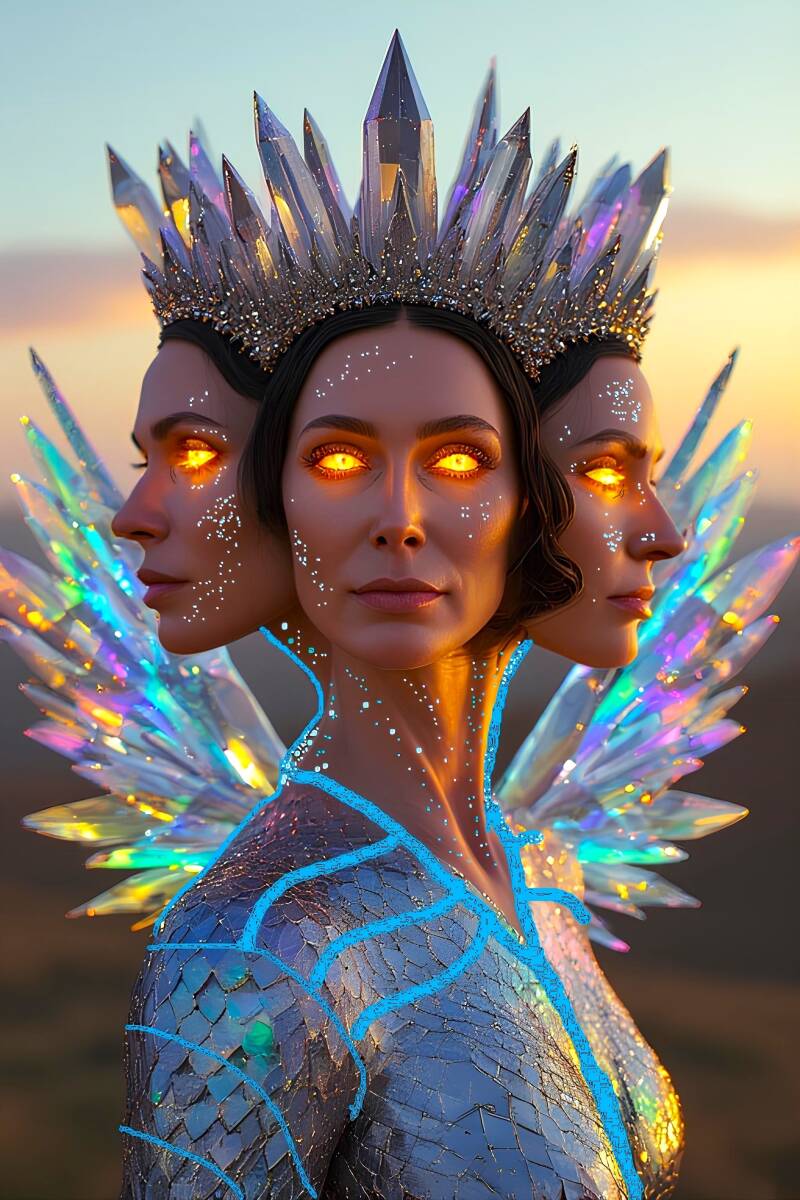
Such angelic beings known in mythology also seem to represent what is human and identifiable in a more cthulhonic way. In terms of cthulhonic beings (not counting giants nor trolls either), many divine beings such as the Kraken and Iku-Turso also share different manifestations of these angel-like qualities, for example in having a large number of heads. Similarly, the hydra from Greek mythology also has many heads, which I discussed in my upcoming Silly Linguistics article about the Canary Islands (unrelated to my PDF books and other publications concerning the Canary Islands). There is a link to dragon trees I discuss in the Silly Linguistics article, and I have discussed other aspects of this whole picture in relation to dragon trees and Cthulhonic beings, tentacled tree-like beings in dreams etc and other dreams, Mayan connections, and much more on this, in my books on the Canary Islands, including in my most recent one, but did not mention the Hydra connection in them, nor is the the content in the Silly Linguistics article in any way connected to that in the PDF books and other publications. I also discuss the concept of divine language of the birds in the aforementioned Silly Linguistics article too, and I have discussed other aspects of this picture elsewhere recently and before, and it also connects with this picture I feel, and is depicted in the AI art in this article and in that showing a two-headed goddess in another article on this site. Of course, divine beings like the hydra, and the other cthulhonic ones, are sometimes said to have so many heads, that, from the implications of this article, the sense of time and language that such a being might experience could be even more unusual to us than that of a being with just two or three heads or faces. This also leads back onto the subject of cephlopod-like beings, which U have discussed in relation to language and ancient things in much detail elsewhere.
I hope that this article was interesting. It is written in honour of all that I love, in honour of the angels and of the Great Spirit/Great Mystery.