95: The O’odham language, Signal Hill petroglyphs & related topics, published on the 27/02/2026
Written and published by Linden Alexander Pentecost. This article was published on the 27th of February 2026, and only on this website. This article was published in the UK, and I the author am from the UK and live in the UK. No AI was used in this article nor in any of my written works. This article contains a total of 2171 words and five photos showing different parts of the Signal Hill site and its petroglyphs, all 5 photos were taken by myself the author, and are located after most of the main text, the photos also have descriptions above each of them in Italics, which contain information not in the main text, and are also important, as is the main text of course and the photos. I have discussed a little on these subjects before in an unrelated publication, with a different photo of Signal Hill in different editions of a book, but the information and photos in this article on this page are different to the aforementioned and this article contains more and different information and photos. I have also published many other separate publications lately including mostly on other websites, including yesterday and the days before, and I will also publish another unrelated work tomorrow. The photos in this article were taken some years ago, when I visited parts of the USA, but this publication was of course published in the UK. The photos are located a fair way down this article.
Arizona has many indigenous cultures. Generally speaking the Pueblo peoples and their Uto-Aztecan languages such as Hopi and O’odham are deeply and anciently indigenous to this landscape. The same I think can be said with regard to the speakers of Yuman languages, like the Maricopa, although since very ancient times the lifestyles of the two groups have been very different, as are their origin stories different.
From what I understand, the speakers of for example Navajo and Apache in Arizona also claim to have ancient spiritual connections to this landscape, and I think that in a metaphorical and otherworldly sense this is true, but in terms of the actual longevity of association and continuity between most ancient archaeological cultures in the area, and the present day indigenous peoples, I feel that the Hopi and some other groups embody and contain this ancient continuity the most.
Uto-Aztecan languages do, from my research, (unlike some other Native American languages) have very few similarities (but some, nonetheless) to languages I speak and am more familiar with in for example Europe. I have observed some similarities though which I have published elsewhere, perhaps naturally, more so to other language families in the Americas. This contrasts with Quechua for example, which contains a large number of lexical and certain other similarities to languages outside of the Americas, including to Uralic, which I have published about in detail.
Some examples of possible similarities seen with the O’odham language for this article, include for example Tohono O’odham kahchk - “lake”, compare Quechua qucha/qocha - “lake” and to Aymara quta - “lake” for example. The O’odham word ban, meaning “coyote” is curious for its similarity to many words for “dog” or “wolf” I have seen across other languages, including for example a similarity to Mochica (a language of Northern Peru) word fanu - “dog”, and to older Finnish peni - “dog” and to other words in Uralic and in other languages. The O’odham word watopi - “fish” or “worm” also bares some similarity to Finnish mato - “worm”. The O’odham word gogs - “dog” also bares some similarity to English “dog” and the Georgian word ძაღლი, [ʒaɣli] - “dog”. The aforementioned O’odham words were sourced from the O’odham - English dictionary on Glosbe.
There is another culture however, who was present in the landscape of Southern Arizona at the same time as the O’odham in the past, and the two tribes were often thought to have been at war with each other and quite different from each other - even though it is generally assumed that this other tribe spoke a Uto-Aztecan language. This other tribe were known as the Hohokam, and they are the tribe connected to the area around Signal Hill in the present day. Some accounts suggest that the Hohokam are ancestral to the O’odham, whilst other accounts suggest that the two peoples were always distinctly different from each other.
I understand that these Hohokam people were connected to the Hopi and O’odham in some way however, and that it is likely that the main linguistic landscape of the Hohokam would have been one of a strong Uto-Aztecan base. Although, when I look at the archaeology of the Hohokam, and the strong similarities between for example certain Hohokam petroglyphs, and Bronze Age Nordic petroglyphs depicting ships and serpent like beings, I wonder if in some way the Hohokam were connected to more distant cultures, at least in terms of their symbolic language, whilst their main language and cultural traits were likely Uto-Aztecan.
Some of these petroglyphs, for example spirals, are also known to the Hopi though, and it could be said that this “symbolic language” does link certain parts of the Americas specifically to certain parts of the Old World, in a way unrelated to the many spoken lexical and other similarities between some indigenous American and Old World languages.
The Hohokam are known for their knowledge of farming and water irrigation, things which some other Uto-Aztecan speaking cultures, like the Aztecs and Hopi, particularly in terms of agriculture, are without doubt a part of.
But the large scale engineering of canals by the Hohokam people also makes them again, in some ways symbolically similar to cultures like the Sumerians and later Middle Eastern peoples who developed agricultural canal systems in dry areas (after a cataclysm or large change, in all likelihood). So it seems to me unlikely that, considering especially many of these cultures used these same systems at the same times in history, that it is unlikely that there was not some kind of connection. It is again worth noting that the spiral and certain other petroglyphs found at Hohokam sites are not representative of all types of petroglyph worldwide, only certain places and cultures seem to use the same primal symbolic language, even if, of course, there are local variations within it. Some of the other petroglyph signs at certain Hohokam sites would not be out of place in for example, North Yorkshire for instance.
Another strange thing about certain Hohokam petroglyph sites, such as that at Signal Hill is that the petroglyphs tend to be inscribed on large, roundish or smooth rocks, which are of a different colour to the bedrock in the nearby landscape. Often these rocks themselves seem to be formed into mound-like shapes, and it is pretty unclear to me how these rocky mounds could have formed through natural processes. Clearly they are sacred and different in some way from the rest of the landscape to the indigenous peoples, hence the petroglyphs, so the question here is, what do they say about how these sites were created? Were they already sacred in the wetter, more ancient past, before the present world came into being? This would coincide with something I wrote in another publication recently about Northern English folklore and the way in which cup-marked stones were sometimes said to have been created when the rock was soft - a concept which aligns well to the Hopi history about the Arizona landscape in the previous world, when the land was wetter and the rocks, in a sense softer and more malleable.
Signal Hill is a good example of one of these sites, and I will go on to discuss this with photos. The “Painted Rock” petroglyph site in Arizona is another example, and is many ways akin to signal hill, with the rocks being of a similar nature. The Chamber of the Sun petroglyph site in Arizona also contains similar megalithic rocks. Another example is the Deer Valley Petroglyph Preserve in Arizona, using similar kind of rocks, although some of them are smaller. The Agua Fria national monument in Arizona, with its own petroglyphs, also has some very unusual stone features, with some of the rocks looking as though they have been altered when soft, or over time.
Below are photos of the Signal Hill petroglyph site, showing different petroglyphs and features, above each of the photos is a detailed description for each photo in Italics.
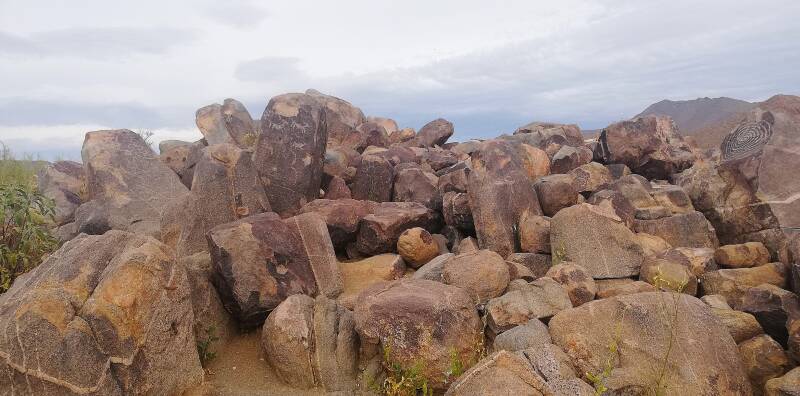
Photo below: an overview of the Signal Hill site, showing the large boulders which are different to the landscape around. Note the way in which the site sits in view of several mountains, including those seen in the distance across the valley. This area generally is part of the Siguaro National Park. Various petroglyphs can be seen in the photo below, including a wheel-like disk, others are also visible. Note the cacti.
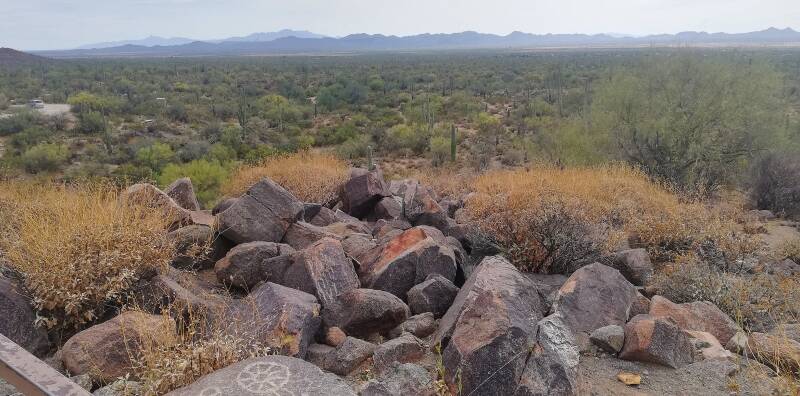
Photo below: a different view of the Signal Hill site, with petroglyphs representing horned animals on one of the central megaliths, and more wheel-like and other symbols on the megalith on its side and to the left of the megalith with the horned animals. Between the two can be seen a petroglyph with a three-pronged symbo, whilst to the right of the megalith with the horned animals can be seen sun-like symbols, disks with lines radiating from the disks. Also on the stone with the horned animals can be seen a snake-like or meandering symbol which appears to have a head at the top, like a snake perhaps. Also on the stone with the wheel-like symbols to the left of the stone with the horned animal petroglyphs, can be seen what may be a V symbol, but I am not sure. Note again the unusual way in which the stones and megaliths are arranged together.
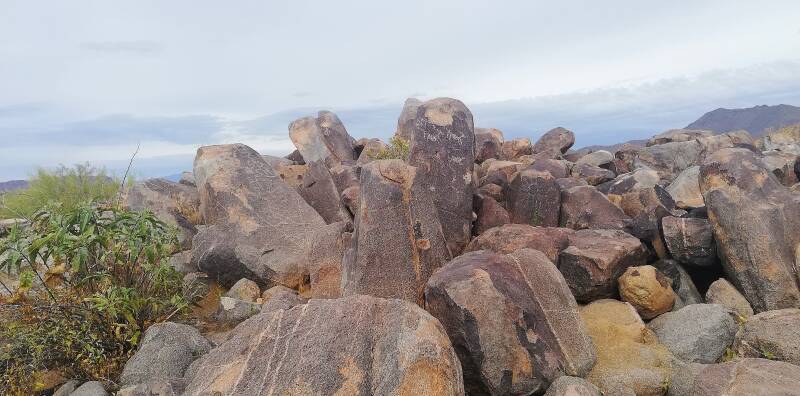
Photo below: more petroglyphs on megaliths. Note the small spiral symbol on the large stone to the right in the foreground, and the three-pronged symbol on a megalith in the background to the left. These three prongs appear to attach onto a larger, more degraded symbol of a circle with a line through the centre. At the top of that stone there appears to be a symbol that looks like an eye. Note again the curious and beautiful arrangement of the stones.
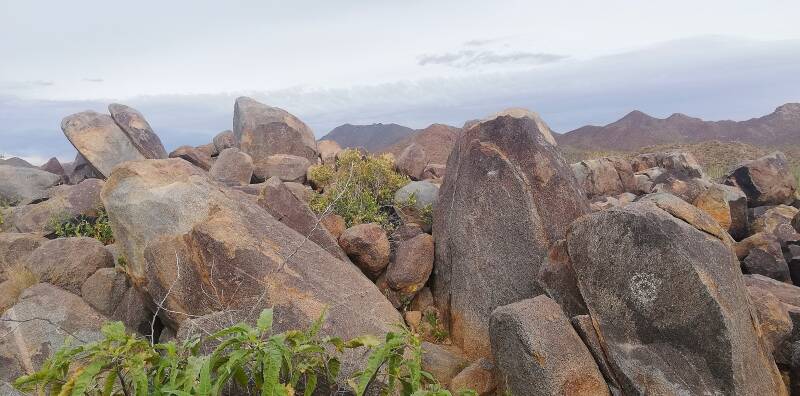
Photo below: another view of the petroglyphs, with several symbols on one of the large megalith centre-left. One of the symbols looks like a scorpion, whilst the one below it looks like a sun, but with a dot in the centre, and lines going out from the outer circle like rays, and then the lines flattening into two-ended prong shapes, the symbol to the right of that is similar, with the central mark in the circle, but the "ray"-like lines off the outer cirle are straight and not pronged, and there are also more lines off the outer circle. To the right of that is an-oval shaped symbol divided into nine parts, eight of which are interlocking around a central one. That there are nine divisions in this oval shape is very interesting I think, given the importance placed on the number 9 in many cultures. On another of the large megaliths, towards the left, can be seen a large petroglyph spiral symbol, with between seven and eight rotations going outwards, depending on which angle one looks at it from. These numbers are also important from a symbolic perspective. Note the cacti beyond the megaliths and the pointy mountains behind.
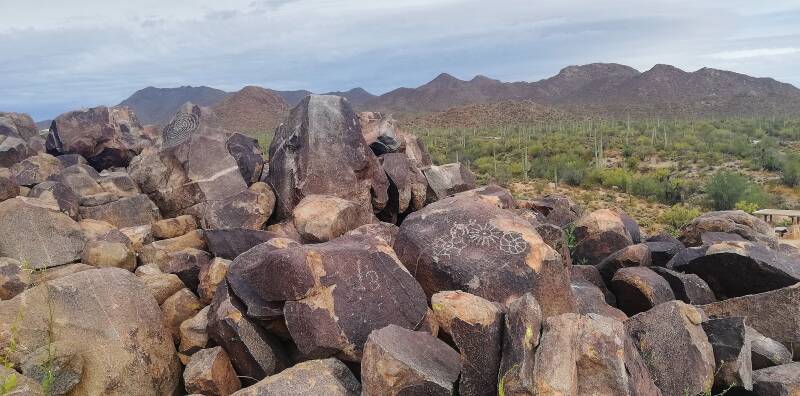
Photo below: another view of the Signal Hill petroglyphs, I wonder to what extent the megaliths that the petroglyphs are upon might have been positioned. Some have said that this site is astronomical in nature, although I believe personally that it also connects to the story of the wider landscape and - in a sense tells the ancient history of that landscape. Perhaps in a sense it explains who those ancestors were and some of the teachings that they imparted. I also generally really like the look of the site, the way that the stones are arranged and angled, their colours, and the way they stand out. It is a beautiful and imposing place.
I hope that this article was an interesting read. This article is dedicated to the Hohokam, O'odham and to all the indigenous peoples of Arizona. I am also thankful to those who took me to this site. I would also highly recommend visiting this fascinating site. I have not yet had the opportunity to visit other petroglyph sites in the Americas, but I wish to it in the future. It was also interesting how, having been to this site, when I was back in the UK a few days later, I went to a petroglyph site in Cumbria, with very similar spiral symbols, also demonstrating how widely spread these spiral motifs are, in certain places. Thank you for reading.