87: On the languages of Sculptor’s Cave & of other Covesea Caves, published 27/12/2025
By Linden Alexander Pentecost, published on the 27th of December 2025. This article was published in the UK and only on my www.bookofdunbarra.co.uk website (this is not the only website I run and publish on, and I publish in other forms too not involving my own websites). This article is unrelated to and separate from all of my other publications. The author is from the UK and lives in the UK. No AI was used in this nor in any of my writing. This article contains 1969 words. Note I have published a lot of things lately, and that it is noteworthy that this article is entirely unrelated to an article I published a few days ago on a different website, where I also discuss witches in different contexts related to Scotland than to in the article on this page, the aforementioned article (not the article on this page) is titled: Polyandry in prehistoric Scotland, & more newly found similarities in Hebridean & Finnish magic, published on the 25/12/2025 . The aforementioned article was not published on this website but on one of my other websites, called: www.languages-of-linnunrata.co.uk . The article on this page in front of you is only published on THIS website (the website you are on: www.bookofdunbarra.co.uk). This article in front of you also contains four images with Pictish symbols on them, drawn by the author but the symbols are some of those found at Sculptor's Cave.
On the northern coast of Banffshire in eastern Scotland, not far from Lossiemouth, there lies a group of sea caves, carved by the sea into the sandstone cliffs. The Picts, are commonly thought of in academia as being simply a P-Celtic speaking group of medieval tribes, not that different from the speakers of early Welsh and Cornish to the south, except for that the Picts were somewhat culturally unique, having a complex pictographic or symbolic language they inscribed onto stones.
In reality, I do not think that this simple explanation adds up. My own research leads me to believe that Scotland would have had many distinct, indigenous peoples and languages, even back in the Iron Age when supposedly - according to mainstream academia, the whole of Britain spoke a single, P-Celtic language. How convenient. Of course, it is entirely possible that this concept is peddled in-part for political reasoning. If academia teaches us about a “one Britain, one language” idea, it enables them to bury and disregard all the other evidence of other indigenous languages, and cultures - something which colonial and post-colonial European countries have been trying to do for many hundreds of years. After all, if they can make people believe they have no deeper, or localised indigenous ancestry, and that we all spoke a “common British tongue”, it makes the population, information, and our history - easier to control. What a strange thought. This is not to say that linguists on Celtic languages do not do fantastic work, rather that it seems to be encouraged to view everything through certain lenses.
Have you ever heard of the “Indigenous Highland Travellers”, and their distinct language, which appears related to Celtic, but which may well be pre-Celtic? A people who only 150 years ago lived in huts akin to those used in Mesolithic times, 9000 years ago, even if - according to mainstream history, such Mesolithic-style huts and pre-Celtic languages have not existed for thousands of years in Scotland, because we were all “one Celtic people” by the Iron Age? I'm not surprised if you haven't heard of them and their language. But they are very real. And they and their languages are just ONE example of an indigenous culture and language in Scotland, that does not fit the mainstream paradigms.
Even in Iron Age Scotland, there was not I think one tribe, one people, and one language. You have to read between the lines to really see what was going on. And from this perspective, let’s look at the culture who we identify the most as being typically “Pictish”, a culture not present in most of Scotland, but which seems to have been focused around northeastern Scotland, particularly the inland areas to the east of the Cairngorm Mountains, but west of Aberdeenshire.
These people seem commonly associated with what most experts describe as P-Celtic place-names, but which I think of as being extra-Brittonic place-names. Extra-Brittonic refers to a language which shares things in common with P-Celtic languages like Gaulish, Welsh and Cornish, but which - in my opinion, may have been a kind of pre-Celtic, connected to P-Celtic languages, but via a pre-Celtic substratum, and not via the more specifically Indo-European aspects of P-Celtic languages. With this implication, the central “Picts”, with their P-Celtic like language, were never the same as the Britons to the south, and were always a distinct indigenous culture, as well as being distinct from other indigenous languages and cultures elsewhere in Scotland.
These central “Pictish” cultures, as I mentioned, are assumed in mainstream academia to have been the same culture as that in Iron Age Britain. They are assumed to have been farmers, with chieftains, with a common Brittonic pantheon of gods. The truth may be altogether stranger.
The most famous of the caves at Lossiemouth is known as Sculptor’s Cave, a cave, so-named, for its Pictish symbols or “symbolic writing” found just inside the entrance to the cave. If we go by my theory, that these Picts were always a distinct indigenous people, present in the landscape, then we can use the concept of linguistic and cultural continuity to look at their deeper past. This assumes the possibility that the ancestral cultures and languages of the central Picts in northeast Scotland, would extend back in time to the Bronze Age, Neolithic and Mesolithic ages.
Scuptor’s Cave attests to this hypothesis. Whilst the cave is famous for its presumably-medieval Pictish symbolic writing, likely writing of a ritual nature, there is evidence of ritual activity at this site going back in continuity to the Bronze Age, and there is also evidence of Neolithic ritual usage of this cave. So, it is possible, that this site represents a kind of ancestral site of the Central Picts, a place where the deeper origins of their culture, and where it came from, can be glimpsed. Furthermore, evidence of archaeological continuity also exists in other caves close to Sculptor’s Cave. Together, these caves are often referred to as the Covesea Caves.
What is even stranger perhaps, is that although we are speaking continuity from the Neolithic up into the medieval period, there is also some evidence that the witchcraft at these caves continued into the post-medieval period. This continuity also contradicts with traditional academic views, because, if the witchcraft and ritual activity at these caves, existed for thousands of years, up until around the 17th century - then it is another indication that pre-Celtic culture and even language remained in Scotland much more recently than is traditionally thought. Of course, Christianity and centralised power put an end to the “larger” manifestations of prehistoric and even pre-Celtic culture, but, the Highland Travellers, and other evidence, suggests that indigenous, non-Celtic speaking cultures, did survive into very recent history.
It is also apt perhaps, that if the Central Pictish culture did originate from the cultural continuity visible at Covesea, that thousands of years later, after Christianity and centralised power had taken over most areas, that vestiges of this ancient culture might continue, out of view, out of reach, in these caves, used by this culture thousands of years earlier. The evidence I speak of is that of a 17th century curse inscribed into the wall of one of these caves, which is another connection to the use of ritual language at this site.
Other evidence of witchcraft continuity in the linguistic sense, exists in the form of a legend, namely that of the Grin Iron Wife, a story that described a witch-like woman, with seaweed-like hair, and green skin, who is associated with the caves at Covesea. She is similar in many ways to what in Gaelic is described as a glaistaig. The story of the Grin Iron Wife becomes even more strange, when we look at the older archaeology of the Covesea Caves.
The Grin Iron Wife is described akin to a corpse with a corporal presence, rather like a zombie, and especially akin to how the draug is described in Northern Norway, as a human with seaweed instead of a head. Thousands of years ago, at Sculptor’s Cave, human heads and whole forms were placed upon stakes and racks, after having been processed, in a sense mummified, and then preserved by the salty air. It is pretty strange and profound that such rituals would have taken place involving witchcraft and post-mortuary processing of adult human forms, only for, thousands of years later, there to still exist a legend about a corpse-like witch associated with these very same caves. I find it almost impossible to believe that this is merely a coincidence.
Pictish symbols/writing examples at Sculptor’s Cave:
The Central Picts, and some outlying groups in Scotland, used a kind of symbolic language. Some are of the belief that these symbols are more purely symbolic in nature, that they represent whole concepts, whole words. Others who have a more metaphysical interest might interpret these symbols as giving details and instructions about patterns of energy, and how to open portals and communicate with the spirit realm. Some, also, are of the opinion that these symbols in themselves represent a fully-functioning writing system, while others believe that they represent personal and family names, identified through linguistic symbols.
Personally, I think that all of these are true to some extent, and that the verdict is still out there. In the images below, I have copied some of the Pictish symbols found within Sculptor’s Cave, with some comments above each image.
Photo below: a selection of some of the Pictish writing symbols found within Sculptor’s Cave. The star-like images to the right in a sense resemble symbols associated with witchcraft in much later periods, but they may be early. The image furthest to the left may be an example of the “Pictish Beast”, a waterhorse-type mythical being, which I have written about much elsewhere. The half moon-like symbol with the lines through, seems to be a variant of the Pictish V-rod crescent symbol. This in some ways resembles the compass symbol in freemasonry. I am not sure about the symbol to the right of it.
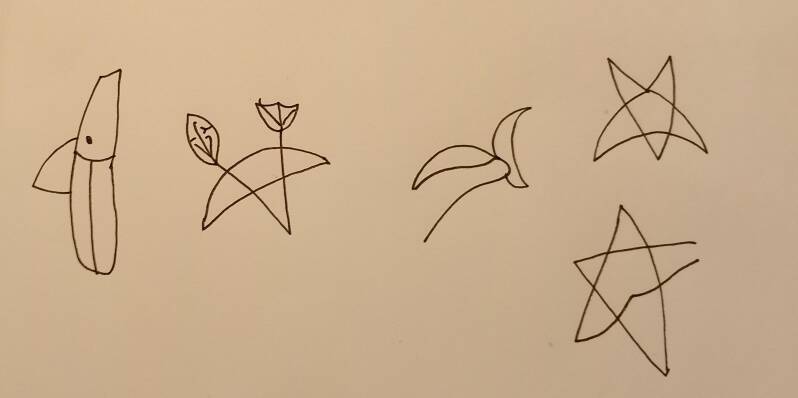
Photo below: another Pictish symbol found within Sculptor’s Cave. This one resembles one box within another. At the centre is a symbol similar to a key-hole. Elsewhere in Sculptor’s Cave this key-hole symbol is found on its own without the boxes around it.
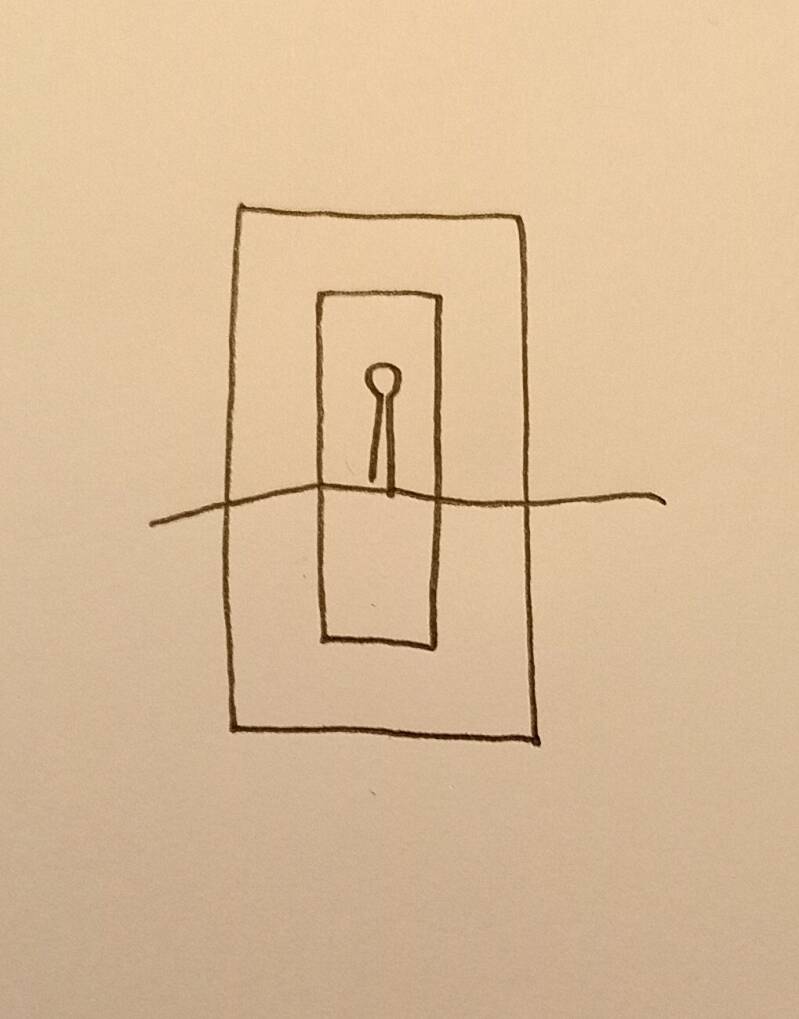
Photo below: another example of a Pictish V-rod crescent symbol, this one lacking certain features that the one on the previous page possesses. I wonder if this was due to a difference in meaning. Note that these are distinctive from the VV marks I have discussed in several places elsewhere - although there could be a relationship between VV marks and the V on some of the crescent symbols found at Pictish sites.
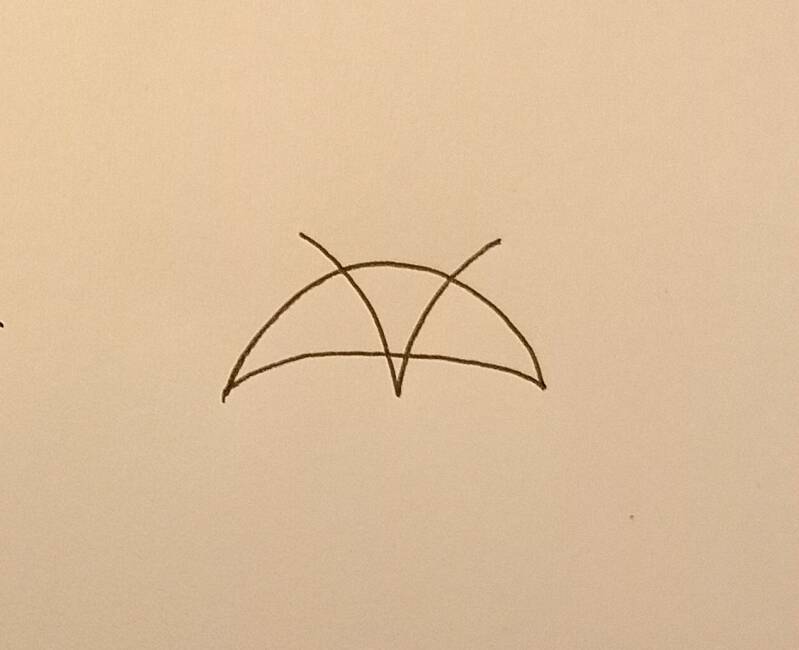
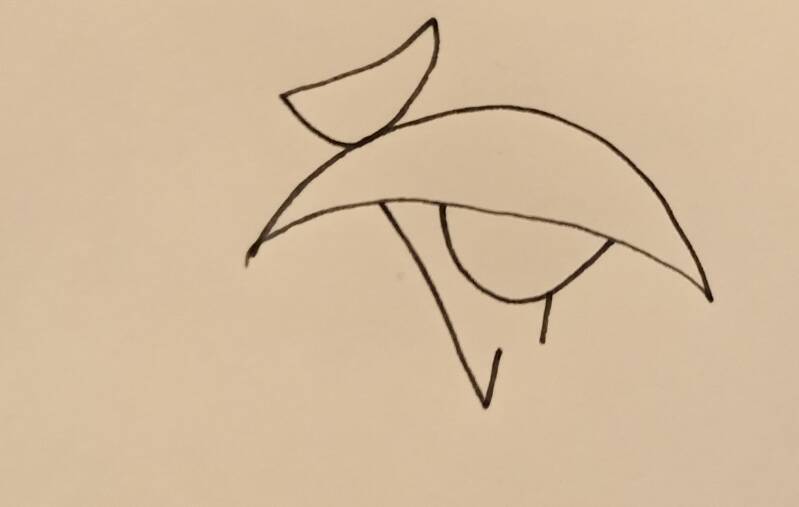
Photo below: another example of a different Pictish V-rod crescent type symbol found in Sculptor’s Cave. This one lacks the whole “V” shape but has two other crescent shapes attached, and other differences. Sometimes these crescent shapes appear on their own without the V. I have written other publications about these V-marks in other cultural contexts in Britain (see paragraph above the picture above this paragraph).
I hope this article was an interesting read. It was written in honour of the Picts, and of those who love Scotland.