85: Languages around the Mogollon Rim
Written and published by Linden Alexander Pentecost, published in the UK and only on www.bookofdunbarra.co.uk . The content of this article is unrelated to and separate from that of any and all of my other publications. No AI was used in this article nor in any of my writings. This article was published on the 15th of December 2025. This article contains 1157 words. The photo in the article was also taken by myself when I visited the Mogollon Rim. Note I have also written unrelated articles about languages around the Mogollon Rim which are published elsewhere and are not the same as this article. The photo on this page is unrelated to other photos of the Mogollon Rim that have been included in some of my other publications. The small text above the photos contains
The Mogollon Rim is a beautiful, mountainous part of Arizona, a part of which lies north of the town of Payson. When I first went to the Mogollom Rim, and went up to the high mountain plateau, I felt I was in a landscape that was not typical of Arizona. The wildlife, including deer, and the pine trees, reminded me of Scandinavia in some ways. There is also a bigfoot-type ancestor known from the Mogollon Rim, known colloquially as the “Mogollon Monster”. I did not encounter it though. In terms of the landscape - indeed many parts of the world, even in hot climates, if one goes high enough into the mountains, they reach the familiar ancient landscapes, some of which resemble a little the boreal forests of Northern Eurasia.
When the ancestors of the modern day Hopi were spread more widely in Arizona, they had a connection to the Mogollon Rim mountains. The Yavapai, a Yuman-speaking people, and the Western Apache tribe, speaking a form of the Western Apache language, also lived historically around the mountains of the Mogollon Rim. Whilst I have been told, personally, and also feel, that the Hopi and some other Pueblo groups are in a sense the oldest indigenous peoples of Arizona (although other peoples also existed in the ancient past), the Yavapai also have an ancient connection to the region; and the White Mountain Apache have their own complex belief systems relating to Arizona and to those mountains, even if officially speaking the Apache and Navajo people are thought to have had a more physical origin to the north, perhaps in present day Alaska.
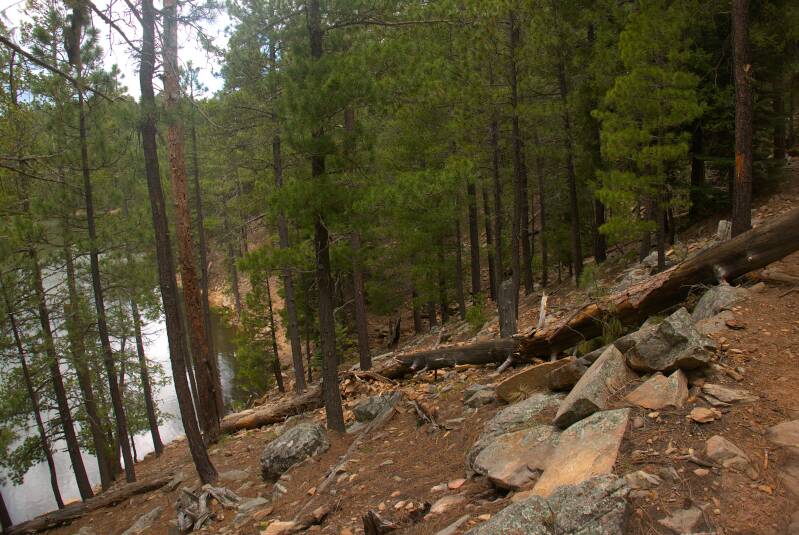
Photo below: Bear Canyon Lake on the Mogollon Rim. This lake has a cool name in English, but it is not very old. The forests surrounding it though give a good idea of the upland landscapes known to the Yavapai and Western Apache who's languages I discuss in this article. God bless the person who took me to this lake. God bless them.
Yavapai is a Yuman language, related to for example Quechan (not to be confused with the Quechua or Quechuan languages in South America), Mojave and Maricopa. In certain senses there is quite a lot of common vocabulary between these languages, and I have discussed for example Mojave, Maricopa and Quechan in more detail elsewhere. The Yavapai word for “mountain” is 'wíi (1). This resembles some other Yuman words for “mountain” and also words for “mountain” or similar in some unrelated languages, which I have discussed before. Compare for example Guanche ife - “ridge” (note that I very recently published an unrelated PDF-book about Tenerife where I talk about the Guanche language and a lot of other topics in a lot of detail). The aforementioned book is titled: Tenerife’s secrets & other related new topics – published via BookofDunBarra UK on the 10/12/2025. I have also discussed Guanche and the Canary Islands in several other publications unrelated to the aforementioned new book. I have also discussed other connections to the ife word in many different, unrelated publications. I also plan on publishing an unrelated new PDF-only book in the next day or so, at the time of writing the article on this page.
Since I am discussing primarily the Mogollom Rim’s mountains, I will also include some Yavapai words for different types of tree. The word for a “white oak” is tník (1), which bares some similarity to Finnish tammi - “oak” and to Breton tann - “red oak” and to the English word “tan”. I also like the Yavapai word hwáala - “pine tree” (1), and the word 'hpálka (1) for palo verde trees.
The Yavapai word for “sand” is hachwá (1), which bares resemblance to a root word I have identified elsewhere, e.g. in Finnish hiekka - sand, and Kali'na Carib sakau - “sand”. This root is found in many Indigenous American and North Eurasian languages, including in languages of the Caucasus Mountains. The Yavapai word for a “mountain summit” is t'órve (1), which can be compared via ancient root words to English “tower”, with a related root in Afro-Asiatic languages, and for example to the word “tor” found in English place-names, referring to a rocky crag or summit. Similar words exist in the Celtic languages.
The Yavapai word hapí (1) means “grinding stone”, and may be cognate to for example Arawak šība - “stone”, and to various other words for “stone” or similar in various indigenous American language families, with connections also observable further afield, e.g. Finnish kivi - “stone”.
The Western Apache language is of course completely unrelated to Yavapai. Whilst I do not speak an Apache language, I can speak some Navajo - not that I have yet had the opportunity to ever meet a Navajo speaker in person. For the most part, words in Apache languages are etymologically related to Navajo words, although sometimes the sound changes make some words look much more unfamiliar to me than others do. For example, Western Apache nn̲ee - “person” is cognate to Navajo diné - “person”, Western Apache tú - “water” is cognate to Navajo tó - “water, and Western Apache łog - “fish” is cognate to Navajo łóóʼ - “fish”. The Western Apache word łog with the second consonant present may I think share a related etymology to a Tsimshian word I recently discussed on a blog post (not on the website you are currently on), where I connected the aforementioned Coast Tsimshian word to Germanic and Finnish words for “salmon”.
I plan to publish a lot more in the near future, including articles, blog-posts and PDF-only books, and possibly a print-only book. I hope that this article was an interesting read. This article is dedicated in honour of the Yavapai and Western Apache peoples.
Sources:
The Yavapai words included in this article and marked with (1) were sourced from the Wipukpa-Tolkapaya Yavapai dictionary online, available to view on the Yavapai-Apache Nation website. The Apache words in this article were sourced from the SIMPLIFIED APACHE DESCRIPTION on the Zybt's Homepage website (now on archive.org), and from the native-languages.org website.