92: Ukko & oak trees & Tapio and Quechua cognates & related topics, also published on the 09/02/2026
This article was written and published by Linden Alexander Pentecost, and was published on the 9th of February 2026, this article is unrelated to and separate from any and all of my other publications. This article was published in the UK and on this UK website www.bookofdunbarra.co.uk and not anywhere else. No AI was used in this publication nor in any of my writing. The author is from the UK and is a resident of the UK. This article contains the following two sub-sections: 1. On oaks and Ukko, and The Green Man, and a dream about a yew tree, and: 2. Word connections between Finnish Tapio and tavata, English ”trap”, and Quechua chapay and taripay. Note that I also published an unrelated blog post/article on one of my other websites earlier today. This article also contains a photo of a tree, likely an oak tree, but it is hard to say for sure, with mist, and the rising sun behind it, taken by a family member and included with their permission, although they do not wish for me to include their name. The photo has not been published before, just like this whole article has not been published before. This article contains a total of 1509 words. The photo is located after the main of the first section of this article and before the second section, above the photo there is also a photo-description in Italics. The photo in this article is also important, as is the photo description above the photo.
1. On oaks and Ukko, and The Green Man, and a dream about a yew tree
It occurred to me recently how oak trees in European folklore are often associated with thunder and with lightning. An obvious physical manifestation of this connection is the way in which oak trees are more likely to be struck by lightning than other trees sometimes, due to their large size, height and also their internal water. In the English countryside one comes across very ancient oak trees, some of which show evidence of having been struck by lightning.
The word ”oak” in English has other cognates in Germanic, and in a few other Indo-European languages, but the original root is likely not of Indo-European origin. ”Oak” is equivalent to Middle English hok, wocke, ake or oke, Old English ác, Scots aik, Cumbrian dialect yak, German Eiche, Dutch eik, Icelandic eik, Norwegian eik, Danish eg and Swedish ek.
In European folklore, the oak tree is associated with powerful gods and spirit beings, often, not surprisingly, those gods associated with lightning and thunder, with wisdom, strength and holy power – all of which are qualities possessed by the oak tree. In England, the mystical figure of The Green Man is often associated with oak leaves, and in many senses, the spirit of the oak is I think akin to a wise old man, a father of the forest, in a similar vein to Tolkien’s concept of the Ents, the tree people.
In Finland, the oak tree is called tammi, and the month of January is known in Finnish as tammikuu, ”oak moon” or ”oak month”. The god of thunder, the old man sky figure of Finnish mythology is called Ukko, whose name also simply means ”old man”. Ukko is also associated with the tammi, oak tree, and what I only recently noticed about this is how there is arguably a similarity between the Finnish name Ukko, and Germanic terms for ”oak tree”, e.g. oak, yak, eik, ek etc. If the etymologies are related, then them seem to me to imply an ancient forest guardian figure, a sky god, and also a bringer of life and protector of the forest, similar to The Green Man in English folklore.
Oak trees also grow to a great age, some of them becoming thousands of years old. They witness the life of the forest, and in a sense, through underground fungal networks and through their own alien intelligence and spirit, they witness, and know, and remember the story of the forest. This is in a similar vein to what I have discussed elsewhere about how the Welsh words for ”vision” and ”wood” are similar, because I think to the ancient druidic mindset, the trees, the forest, and the fungal networks, were symbolic of and directly connected to mind, wisdom, history and intelligence.
Please note, that in another article I published quite recently on this website, I discuss other mystical aspects to trees, including more on fungus and on dragons, the aforementioned article is titled: 90: More miscellaneous mythology discussions, also published on the 12/01/2026 . I have discussed many other aspects to these topics in yet other publications.
I also recently had a very memorable dream, but involving a yew tree rather than an oak tree. A friend has recently moved away, but I feel that they really connected to the land where I live. In my dream, I found an ancient oak tree, kind of on its side and on a hillside. I crawled into a hollow, and inside I met my friend. We sat on an ancient surface of inner wood, forming a kind of level within the hollow of the tree. We looked up into the higher parts of the hollow tree, and I remember thinking that the shapes of the wood made the place akin to a small cathedral. Whilst I saw the brownish red colours of the yew wood, there was a colour of incandescent greenish-blue as well. It was a nice dream, and I told my friend about it, who seemed also to find it spiritual and meaningful in their connection to the land.
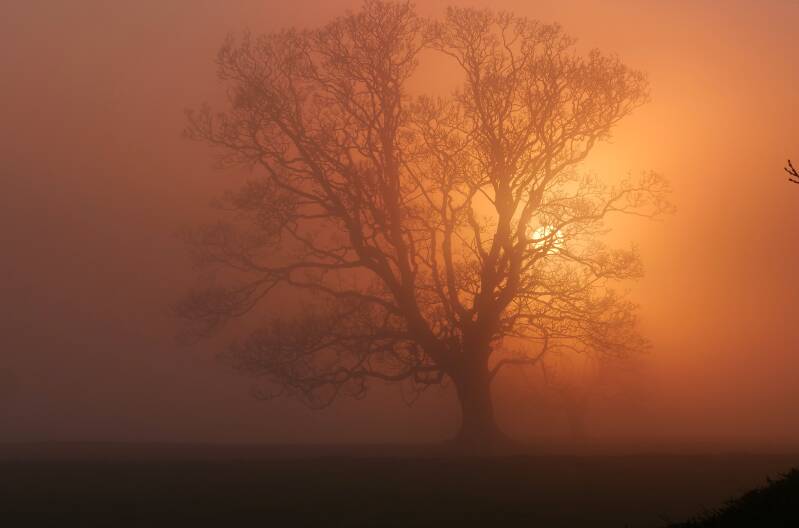
Photo below: a tree, most likely an oak tree, located near Levens in Cumbria, and taken by a member of my family and used with their kind permission, although they do not wish me to include their name. The photo below shows a misty sunrise, with glowing vapour or mist, illuminated into warm colours by the glow of the sun, visible just behind the tree. This photo does I hope help to invoke the sacredness, majesty and magic of oak trees, and to invoke and give honour to those wise gods who are associated with and who guard their wisdom.
2. Word connections between Finnish Tapio and tavata, English ”trap”, and Quechua chapay and taripay
In the second part of this article, I want to discuss a single recently-discovered Quechua-Finnish similarity. Normally I publish several of these at once, but thought I would include just this one in this article, as it is also relevant to the subject of trees, and specifically to another Finnish god, called Tapio.
Finnish Tapio is the name of a forest god of Finland, and sometimes a “forest” in Finnish is referred to as Tapiola literally “Tapio-place/realm”. This word in Finnish is derived from the verb tavata which means “to meet” or “to face”, but in the Finnish mentality in relation to Tapio, this “meeting” connects to the idea of “hunting”, that to “hunt” is to meet or face an animal etc - this is because Tapio is a god associated with hunting.
We can see a similarity between these words and the Quechua word chapay which means “to catch”, and also the Quechua word taripay which means “to meet with” or ”to catch up” or ”to consult”, which also connects to the semantic meaning of tavata more so than chapay does, although both Quechua words reflect different aspects of the root word's meaning in Finnish, with chapay reflecting the phonologies of tavata and Tapio most closely. There is a possibility that Finnish tavata is related to the English verb “trap”, distantly, and we can see that whilst chapay reflects the phonology of tavata more closely than taripay does, so does taripay reflect the phonology of the English word “trap”. Interesting, huh?
For those of you who want to feel a bit of the magic of Finnish forests and who are not planning to actually go and visit them, I would say that the classical piece of music, Tapiola, by Sibelius, is incredibly beautiful and awe-inspiring, and invokes the power of Tapio. Perhaps it is not merely chance that this sacred word in Finnish is connected to Quechua and English words potentially. Also I do not feel that the word ”trap” in English nor that chapay in Quechua quite semantically match what these words originally meant, I feel that in a fundamental way, these words pertain to the idea of ”meeting” the forest, meeting Tapio, the Green Man, the father of nature – and this also connects back to Ukko in a sense. Note I have published other Finnish – English similarities elsewhere, and a great great many more Quechua – Finnish similarities in other publications.
I hope that this article was an interesting read. It is written in honour of Tapio, of Ukko, and of The Green Man and of all forests.