98: More on Orkney's Twig Runes & prehistoric context, published on the 05/04/2026
This article was written and published by Linden Alexander Pentecost on the 5th of April 2026. Note that recently I have published an awful lot of other publications incl. PDF books published via this website, articles in many places, and different articles published on many websites and elsewhere, that discuss, pertain to and contain unrelated, different examples of runes and ancient writing in general with many specific examples, and also I have done the same in publishing many, many, many unrelated publications which discuss ancient writing (some of it including Orkney's non twig-rune Neolithic writing, Pictish writing, Ogham writing, and other forms of writing) on the Orkney Islands, along with a vast array of other connected and interconnected topics. Note that this article is thus unrelated to and separate from any and all of my other publications. No AI was used in this article nor in any of my written publications. This article was published only on this UK website, and was published in the UK, I, the author, am also from the UK and I live in the UK. This article contains a lot of main text not in italics, which is followed by 7 photos of detailed drawings showing examples of twig-rune inscriptions in the Orkney Islands, above each of which are detailed and extensive explanations in italics providing even further information about each example, and how we might possibly interpret them and read them, when they can be read, and other information. Note that not too long ago I published an unrelated article/blog post on a different website, one of my many, many separate, publications about ancient language in Orkney, wherein I also discussed one of the examples discussed here, albeit with different information included, the link to this article is included in the description in italics pertaining to Unstan Chambered Tomb. This article contains a total of 3173 words and 7 photos of detailed drawings of these inscriptions. Some updated were added to this article towards the end of the day on the 5th of April 2026. The photos of the inscription drawings in this article are also very important as are the much larger main texts and texts in italics of course.
The Orkney Islands are a fascinating archipelago off the north coast of Scotland. The islands are often called “Viking”, but there are major problems with our understanding of this timeline. I have written a lot about the subject of ancient language and inscriptions in the Orkney Islands in other publications, as this subject has interested me ever since my first visit to the islands in 2008. On my second visit to the Orkney Islands, I was shown an example of possible prehistoric writing, found at Banks Chambered Tomb on the Orkney Island of South Ronaldsay. I have written extensively about this and about other possible examples in different publications.
The thing is, there are three “accepted” writing systems known to have been used in Orkney, not including the Latin alphabet. These are the Pictish symbolic writing, the Ogham alphabet, and a form of the Younger Futhark Runic Alphabet. I would argue though that there are at least two other categories, which are not officially accepted in academic circles as meaningful, they seem in fact to be deliberately ignored, and I remember one professor simply telling me to pay no attention to or to ignore this subject. I did not take his advice. The aforementioned subject is that of possible Neolithic writing in Orkney, many of the characters in the examples are rune-like, but they are not runes, nor are they twig-runes.
Another example of mysterious writing in Orkney, the fifth category, is that of Twig runes. Those in Maeshowe chambered tomb are considered genuine, but most of the others are ignored and considered to be recent fakes. In one instance, one of these Twig-Rune inscriptions was apparently admitted to having been created by a person working on an archaeological site. The only problem is, that this comes only from one testimony, and I have wondered if this story was made up by the person, who has now passed away – if it was made up to avoid the awkward question of how these runes appeared at a Neolithic site.
I am not suggesting that there is some kind of cover up, but there are some slightly dubious and suspicious things. There are in the Orkney Islands, what are most likely very modern runic inscriptions, for example, Cuween Chambered Tomb contains an inscription reading INGIBIORH which is likely simply copied from an actual inscription featuring this name within Maeshowe Chambered Tomb. There are also other modern runic inscriptions in Orkney, which are in English and which tend to use a “version” of the runes that is most likely to be found on the internet.
However, there are also Twig-Rune inscriptions at Neolithic sites, which definitely do not look modern, and I don’t personally believe that they are. One is found in Cuween Chambered Tomb, close to the most-likely later fake inscription. Whilst the Twig-Runes in this chamber do look genuine, they are most easily explained as fakes, because the tomb remained untouched for a very long time, and there is strong evidence that the Norse entered the chamber to carve Twig-Runes. Having said that – Twig-Runes are a very specific and mysterious form of runic writing, and I think it very unlikely that they were added recently. Twig-Runes are such a specific type of runic writing, that to be able to accurately carve them, as they are in Cuween Chambered Tomb, is not something that many runologists would even be able to do – let alone other historians or members of the general public.
It seems that archaeologists and linguists in general are reluctant to seriously approach the subject of the other two categories of writing on ancient Orkney, because the acceptance of these other forms of writing would cause a major problem to the accepted timeline of history on these islands.
Both the Runic and Ogham alphabets are “officially accepted” as coming from Latin in some way. So when symbols or even possible inscriptions appear in association with Neolithic sites, from thousands of years before the Vikings, it shakes the foundation of this idea that there was no writing in Britain before Latin. The examples of possible non-runic and non-twig rune writing are found at Skara Brae and Banks Chambered Tomb, there are also other possible examples I have discussed.
Twig runes were also found at Skara Brae, and at Maeshowe Chambered Tomb (alongside other runic inscriptions), at the Ring of Brodgar (a stone circle), and at Unstan Chambered Tomb, with some other examples. The two reasons many of these twig-runes are not generally accepted or taken seriously, (excluding the possibility of deliberate suppression of information), are, their context, many of these sites were only opened recently, and Twig-Runes are associated with the Norse, so they are assumed to have been made only since these sites became opened as archaeological sites, for the most part, and long after the Norse period. And secondly, when these twig runes are pronounced they do not make much sense coming from a Norse perspective.
If they are genuine, it would imply that we are either pronouncing these rune-like symbols wrong, or that they are spelling something in an earlier language than Norse, or both of the aforementioned possibilities may be true to different degrees. Twig-Rune inscriptions in general including in Norway, are often considered to be “meaningless nonsense words”, simply because they cannot easily be read. Of course in reality, calling something nonsense simply because one doesn’t understand it, isn’t a very good attitude
Photo below: a drawing of some of the twig runes within Maeshowe Chambered Tomb, these are some of the most elaborate and famous on Orkney and they are located beneath a larger, ordinary Orkney runes inscription. Again the meaning of these runes is very difficult to interpret. According to my understanding of what is "known" about how to read Orkney Twig Runes, the first character on the left might be an A, although there is a line through it which makes it confusing. The second character could be a thorn, Þ, but it is again abstract, the third character, going right, could be a an L, although again it is abstract, the fourth character going along, could be an I, the fifth character, going right, could be a Y/J/TS a form of the rune ýr, and the final rune most towards the right could be an R, thus these letters would read: AÞLYR or AÞLTSR, which doesn't make any sense through Norse, although I am sure that others have made other interpretations. Nevertheless, even this most-famous of examples demonstrates how difficult these runes are to interpret. Note that there are also other twig runes in Maeshowe Chambered Tomb which I do not discuss in this article.
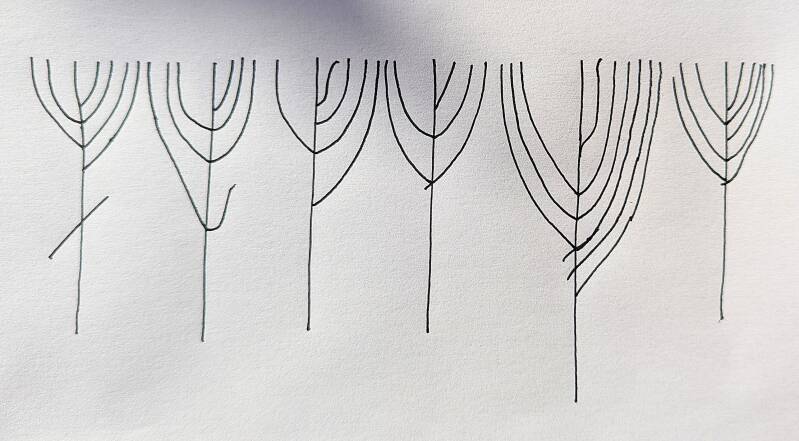
Photo below: a drawing of the twig runes found on a stone at the Ring of Brodgar, the first character furthest left could be an N, but it is again abstract and with the branch lines not joining to the same parts of the main stem, the second character, moving right could be a very abstract T, although no such character of this appearance is understood in twig runes, although the character does look a little like runes for the sound I, the third character, to the right again, could be an O, except that it is reversed, with the four branch lines on the left and not on the right, so this cannot accurately be read as an O, the character to the right of which could be an U, the smaller character to the right of which could be an N. So basically, this would read as something like NTOUN or as NIOUN, neither of which make any sense through Norse, although some have suggested that these characters spell the name BIORN - but I myself am not at all convinced. The cross below the inscription may have linguistic value also, but this is not determined, neither is whether or not the cross is Christian or pre-Christian in origin.
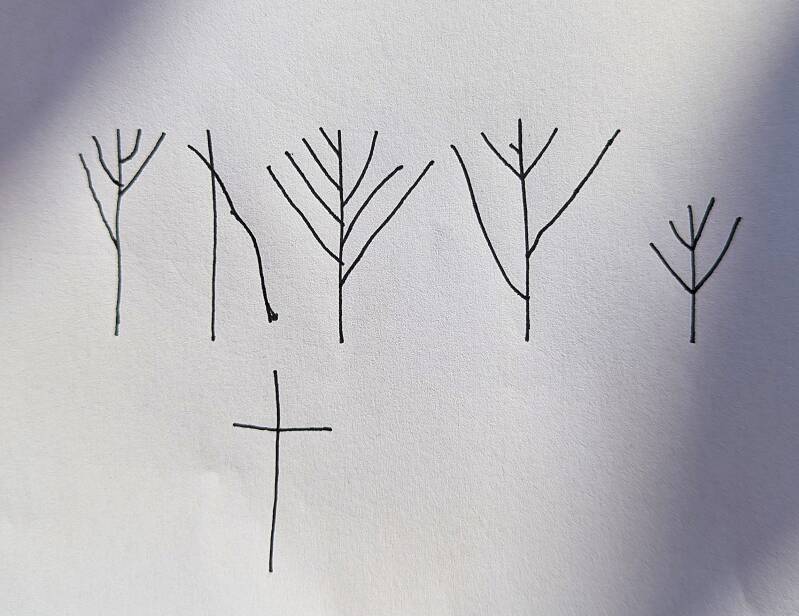
Photo below: a drawing of the twig runes found on a stone at Skara Brae (this is not the same as the other example of Neolithic writing at this site, which I have discussed elsewhere in much detail). The inscription shown below shows two lines of text, according to: "RUNIC TRADITION IN ORKNEY: FROM ORPHIR TO THE BELSAIR GUEST HOUSE Michael P. Barnes" the upper inscription represents IBA and I also think that this is the case, but note that I have accidentally drawn this as the lower inscription rather than the upper one. On the upper line (what is in reality I believe the lower line, but what is shown as the upper line in the image below), the first character is unreadable. The second letter, moving right, is also unreadable. The third rune to the right of this could be an "A" but then it is more akin to how A is represented in the Orkney Futhark and not in the Orkney Twig Runes, furthermore, the second character can also be seen as akin to a reversed runic K, and the first character bares some similarities to the runic letter Thorn. The second line, below (what is actually the upper line), could begin with an I on the left, although two of the twig lines are coming off the bottom, which is again unusual, the second character could be a B, the third character could be an A, again assuming the repositioning of some of the branch lines, and so the reading would be IBA, which again, makes absolutely no sense through a Norse language.

Photo below: a drawing of the Stackrue Disk, a disk-shaped object found close to Maeshowe, which also possesses twig-runes. This object may also have a prehistoric context, although many seem to regard it as a fake simply because it does not fit the preordained acceptable historical timeline, which many archaeologists and historians have to "confirm" to if they want to be employed by universities etc, which is sad, when you think about it. A similar disk was found on Orkney, namely the Buckquoy Spindle Wheel, which has upon it an Ogham inscription. It is noteworthy that Ogham was sometimes written in a circle, and sometimes the circle was "divided" into four parts, one for each "aicme", the Buckquoy Spindle Wheel is however an inscription in a circle, whereas the Stackrue Disk is more akin to the Ogham writings which divide the alphabet into four parts. Again, the Stackrue Disk contains rune-like letters which are unreadable, although the upper left part of the circle contains what appear to be ordinary, or more-general looking Orkney runes that might read KUÞ meaning "God" or Good" although the U rune is not exactly certain (the central rune in the upper left of the circle). In the upper right of the circle, is what could be read in twig runes as a letter L, although it can't be really, because the rune is reversed, and which is followed slightly below it by a Younger Futhark A or Æ, so something like LA or LÆ, which again makes zero sense through Norse. The character(s) in the lower left part of the circle seem to read as a more-ordinary runic R, although there are some lines there which do not quite make sense, whilst the characters in the lower right of the circle may be a H twig-rune, to the right of which is an undetermined smaller rune-like symbol which could be read as a runic N. Again, whilst this disk does contain both twig runes or twig-rune like symbols, and rune-like symbols, the characters are largely unreadable.

Photo below: a drawing of one of the twig-rune inscriptions within Unstan Chambered Tomb, I also discuss other aspects of this in an unrelated blog post on a different website, wherein I also include a photo of this inscription showing different details of it to those shown here, the link to which is (to the article): https://www.languages-of-linnunrata.co.uk/3049095_on-some-other-new-previously-undiscussed-aspects-topics-discussions-march-2026-unrelated-to-those-discussed-described-in-my-other-publications-unrelated-to-those-discussed-in-my-pdf-book-published-last-month-aspects-of-ancient-writing-in-orkney-published-on-the-08-03-2026 . A thing which I did not notice until now, is how the bird carving seems to be a part of a very large twig rune furthest left, which is unusual because there is one branch of this twig rune, which then branches off again. Whilst these are likely forms of twig rune, they are not readable as twig runes, and the larger symbol furthest left cannot at all be read as a twig-rune, as none of the readable, known twig runes possess a branch which branches again in this way, nor do any of them lack any branch on the left side. The character to the right of this is cross-like, but could tentatively be read as a form of the runic N, the character right of this is a line with a circle carving above, of unknown meaning, the character to the right of which resembles an Orkney runic T, but is in many ways more akin to one of the characters found in the Neolithic inscription at Banks Chambered Tomb. The character to the right of this may be a runic K, and the character furthest right may be readable as a runic F, so the last three characters might be read as TKF, which again akes no sense through Norse language, and, alongside the other characters, the inscription is in general unreadable.

Photo below: a drawing of another set of Orkney Twig-Runes found in Unstan Chambered Tomb. These twig-runes or twig-rune-like letters are entirely unreadable, with the first rune furthest left being especially complex in its branches, note again the use of branches off the main rune stem which then branch further. In the upper part of the twig rune furthest left is what looks like an apotropaic butterfly marking incorporated into the rune, the character to the right of which vaguely resembles a Latin K, after which is what appears to be a vertical line twig-rune, followed by a twig rune that vaguely resembles a reversed thorn rune, followed by two other twig runes that seem to consist of only vertical lines. The dotted area in the drawing below represent lines which I was not certain of. Of all the examples of twig runes in Orkney that I know of, that shown below is perhaps the most unreadable. Note that there are also modern runic inscriptions in both Unstan and Cuween chambered tombs, as well as the what I believe are ancient twig rune carvings present in these tombs, I do not cover the moder examples in this article for obvious reasons.

Photo below: a drawing of the twig-runes in Cuween Chambered Tomb, the character furthest left seems to be an F, the character to the right of it is what looks like a H, the character to the right of which is unreadable, but note the various lines, not obviously attached to it, but coming off it, which may be connected to or a part of this character, in which case it could be a very abstract Orkney twig-rune L, with many of the lines coming off the bottom rather tha the top. The final character furthest right is what appears to be another F rune, but again with the lines not quite joining up, and with the branch on the right also having another branch coming off it, further confusing the possible reading. If these letters are as I suggested then they would seem to read as FHLF, which, again, makes absolutely zero sense in any Norse language.

I hope that this article was an interesting read. This subject sure does require more research and attention, and I am saddened that this subject, like other aspects to ancient written language on Orkney, seems to have been largely ignored. I am hopeful that this article helps to encourage further interest and research into these twig runes, and I hope that in the future, when I better understand examples of twig-runes in Norway, I will be able to discuss and publish about more aspects to twig-runes in general. This article is written in honour of the people of the Orkney Islands - may they continue to be inspired by and to connect to their beautiful ancient history, for it is important and magnifiscent beyond belief, particularly in terms of ancient writing. This article is also written in honour of those ancestral cultures of the Orkney Islands, the presence of whom I first felt back in 2008, when a friend and I, and his dad, visited the Tomb of the Eagles on South Ronaldsay. I remember the autumnal sea breeze, the salt in the air, the wildness, the feeling of closeness to and the presence of an ancient clifftop, likely bird-hunting tribe of these islands. It seeped into my soul and its magic continues to inspire me.