99: On pre-Ogham writing at Pluais na Scríob & related sites, published on the 13/04/2026
Written and published by Linden Alexander Pentecost and published on the 13th of April 2026. The drawing (photo of the drawing) was also drawn and photographed by myself the author. This article is unrelated to and separate from any and all of my other publications, and no AI was used in this publication. This article was published on this UK website and was published in the UK, the author is also from the UK and a UK-resident. This article contains 1148 words.
In Ireland there are a number of sites which possess what might be called a sort of pre-Ogham notational writing. It is unknown when Ogham lines became established as an alphabet, but there are many examples of what appear to be a kind of pre-Ogham, not necessarily readable as a formula in am alphabetical form, but nevertheless, I think likely formulaic in some way or other. One of the more well known,but still not widely known examples of this is at a rock shelter on the Béarra Peninsula in County Cork/Contae Chorcaigh, the rock shelter being known as Pluais na Scríob.
This rock shelter contains a huge number of incised lines, many of which occur in sets of several vertical lines positioned upon a horizontal axis line, which is generally similar to Ogham, yet these markings are seemingly not readable as Ogham, at least not in the alphabetic sense, which is not to say that these inscriptions are not formulaic and readable in some linguistic sense. They likely I think represent the recording of information. Perhaps they are like the Ogham stones in that they record primarily hereditary information about the ancestors and clan associated with a particular place. Or perhaps they instead represent information about the cycles of nature, or even some kind of prophetic information, similar perhaps to the oracle bone script used in ancient China.
Whichever the case, I feel that the markings in Pluais na Scríob are no doubt connected to the sacred landscape of Béarra and to the sacred knowledge of its ancient indigenous people. It is also noteworthy that these markings are similar to the so-called arrow markings, more likely apotropaic markings, found in parts of Wales, including in Gwynedd. This makes me somewhat curious whether or not these markings were culturally connected to the Bronze Age copper mining culture, which was found in Western Cork and Western Kerry, in Munster Ireland, including on the Béarra Peninsula, and which was also present in North Wales. This is not to suggest that the mining cultures in these areas were the exact same cultures, but these cultures were no doubt connected, and could have used the same symbolic language. Given also that the Pluais na Scríob is a kind of "cave" - not so different from the prehistoric copper mines located in Western Cork and Kerry, it is also not difficult to imagine some possible connection here.
A really interesting question here, in addition, is - do any of these Ogham-like markings also exist at the Bronze Age copper mines in Western Cork and Kerry? The most famous of these copper mines is on Ross Island, on Lough Lean/Loch Léin near Killarney/Cill Áirne in Kerry. But there are other, smaller Bronze Age copper mines in this part of Ireland, some of them going at least a metre or two underground. Do these other mines, many in isolated locations, possess any kinds of markings or carvings on their walls? Has this even been looked into yet? There is also the fascinating question surrounding possible Ogham writing in the Americas. But I will discuss this in an unrelated publication -soon.
Below is a drawing I did of a certain area of the carvings in Pluais na Scríob. Please note that unlike my other drawings of ancient writing examples which i have published, the image below does not depict the carvings one hundred percent accurately, partially because i cannot see them close up enough from the photos I've seen,and partially because there are just so many lines visible in the images that I have only concerned in one small area of them visible in a number of photos. The drawing and the lines in general makes think of Ogham as a kind of static language in the air, like vibrations,language, normally invisible in reality but given structure and physicality here,a bit like when Neo can see the coding of the matrix in his reality, as shown in the matrix movies.
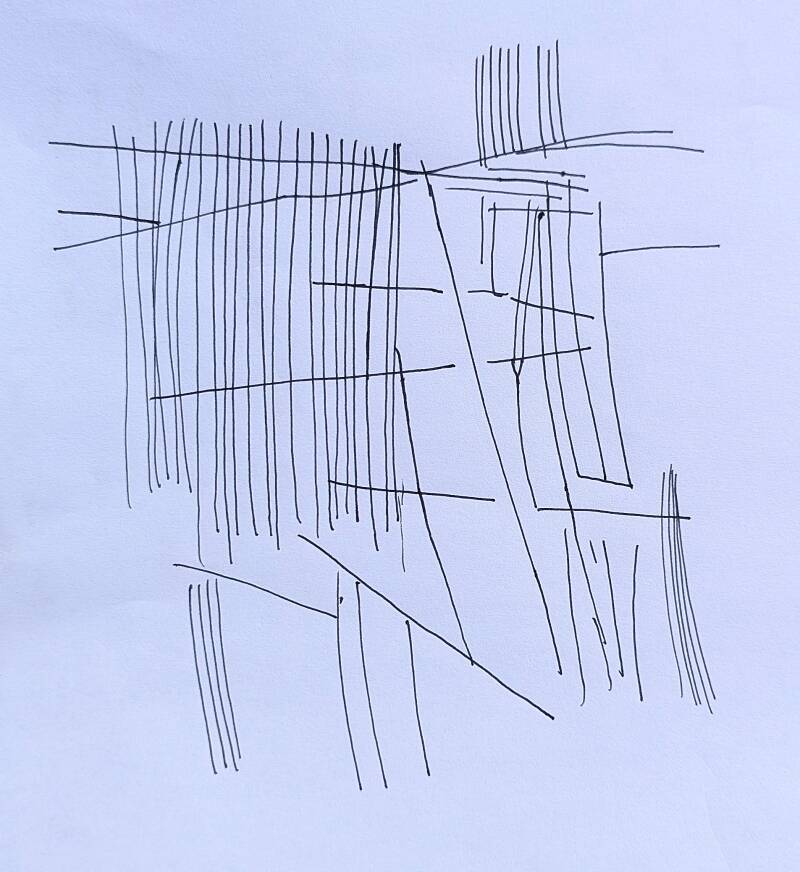
I am doubtful that these markings are representing lunar or solar cycles if I am honest. The numbers of lines in any particular area do not seem to correspond well to lunar or solar cycles, at least from what I can gather. I feel in some way that these were marks left by ancestor beings in some way - instructions, showing us something. Maybe they are formulaic, words in a sense. But maybe they were also showing us the hidden language of reality, and how to unlock it - just like in "The Matrix".
There are similar Ogham-like symbols found at another rock shelter in Cork, known as Cooleenlemane rock scribing, and this is a similar kind of location, formed from a boulder, - similar to that at Pluais na Scríob. The Ogham-like symbols at Cooleenlemane look deeply cut and are more sporadic, i.e. they do not cover the entire walls like those at Pluais na Scríob and are in a sense more Ogham-like, but I still cannot read them. From what I understand, there is also a very similar rock shelter, again formed from one boulder leaning against another, located near Coad on the Iveragh Peninsula, this cave is known as Cáit na Pluaise's Cave, after a lady who lived there. I wonder if this lady was descended from a much more ancient culture connected to this site. Cáit na Pluaise's cave also contains Ogham-like markings, but also apotropaic markings. It seems that a midden of seashells is also found in this cave. Whilst this midden is associated with Cáit na Pluaise herself - I wonder if her lifestyle was connected to the much more ancient tradition of seafood foraging and shell middens in Ireland. See my recent article regarding midden caves on Jura at the following link on one of my other websites: https://www.languages-of-linnunrata.co.uk/more-on-the-jura-gaelic-dialects-ancient-jura-connected-topics-published-on-the-11-04-2026 . An example of the arrow markings I mentioned in Wales is that of the Ffridd Newydd Arrow Stones in Gwynedd. Another is the Moel Faban Arrow Stone, also in Gwynedd. There are also other examples of these Ogham-like markings in Ireland which I have not mentioned in this article.
I hope that this article was an interesting read and thank you for reading. It is dedicated to the ancestors who created the markings I discuss in this article and to my beloved family.