91: Lacey’s Caves: a modern folly or a prehistoric site? And also published on the 29/01/2026
site? And also published on the 29/01/2026
Written and published by Linden Alexander Pentecost. This article was published o the 28th of January 2026, two other unrelated articles/blog posts on a different website were also published by me today on a different website. The four photos in this article were also taken by the author. This article is unrelated to and separate from any and all of my other publications; no AI was used in this article, this article was only published on this UK website www.bookofdunbarra.co.uk - the author is also from the UK and lives in the UK. This article contains a total of 902 words.
As I mentioned in article 89: on this website, the Eden Valley, specifically the sandstone areas around the River Eden itself, and the River Eamont, contain many examples of rock-cut caves. Different explanations are provided for their construction, but generally I get the impression that whilst these caves were used many times after their original contruction, that the people reputeded to have built them probably didn’t build them, their names and occupations being attached to these sites to provide an easy explanation for why they are there.
The most famous example of such caves are Lacey’s Caves, which were supposedly carved in the 18th century by a Colonel Samuel Lacy. Either the Colonel merely attached his name to the site, to provide an explanation for their existence, which is more likely, or the Colonel had a deep knowledge of prehistoric sandstone cave sites elsewhere in the World, and also had a knowledge of ”spirit doors” and the vibrational properties of sandstone. Like the extensive sandstone caves near Wetherall and Great Corby, Lacey’s Caves are of a much similar design which is found in many other parts of Europe, for example at Klusfelsen in Germany, Anchor Church in Derbyshire, Woden’s Den, a now-destroyed ancient church-like cave structure near Manchester, and many other such sites, some of which I have discussed esewhere.
Lacey’s Caves is located rather dangerously close to the cliffs dropping into the River Eden, and great care must be taken when visiting. The site contains several entrances into large chambers, with interconnecting passages and some darker chambers. Present also are holes cut into the walls and various ”spirit doors, i.e. doors which appear to lead nowhere, but which probably don't. I discuss more on them in other publications, including in several on this website.
Photo below: a chamber in Lacey's Caves, with an entrance to the cliff allowing daylight in, in addition to the passage entrance on the left, and to the spirit door on the right. Note how the spirit door in particular seems well-carved, and note how this site bares similarity to sites such as Anchor Church in Derbyshire for instance.
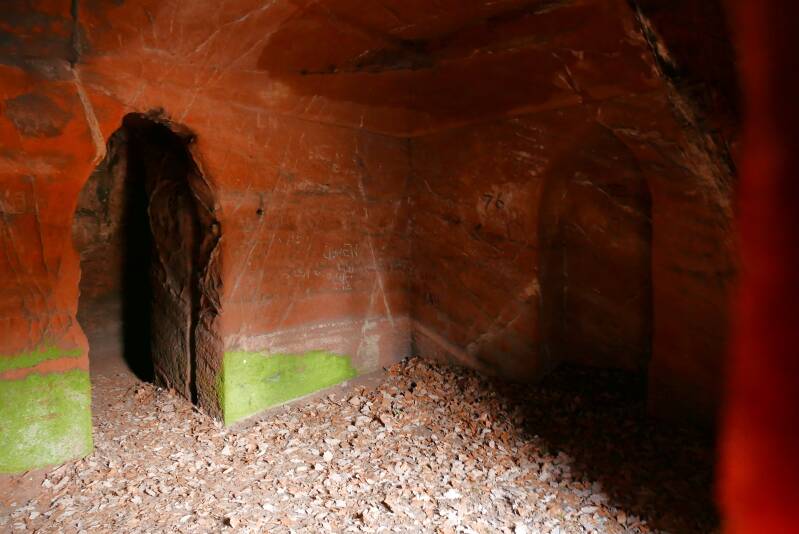
Photo below: a length of tunnel within Lacey's Caves, connecting the back parts of various chambers. Note how another doorway can be seen at the centre of the image, further back from the first, which connects the following chamber to the one after. Note again the similarity of the shape of the tunnels to for example doorways and tunnels within churches, something to do with acoustic properties perhaps?
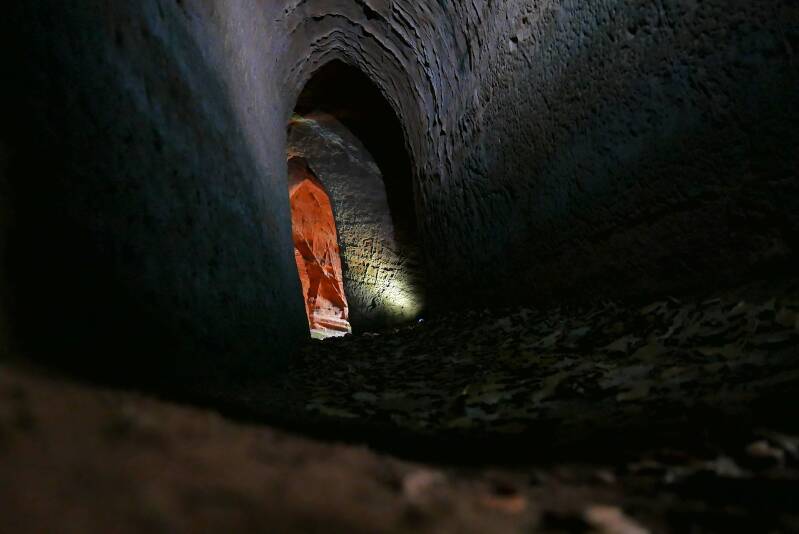
Photo below: part of the area outside of Lacey's Caves. Note how the rock wall to the left has marks similar to cup marks. These may be natural, at least in part, but I have noticed them at the entrances to other caves along the River Eden too.
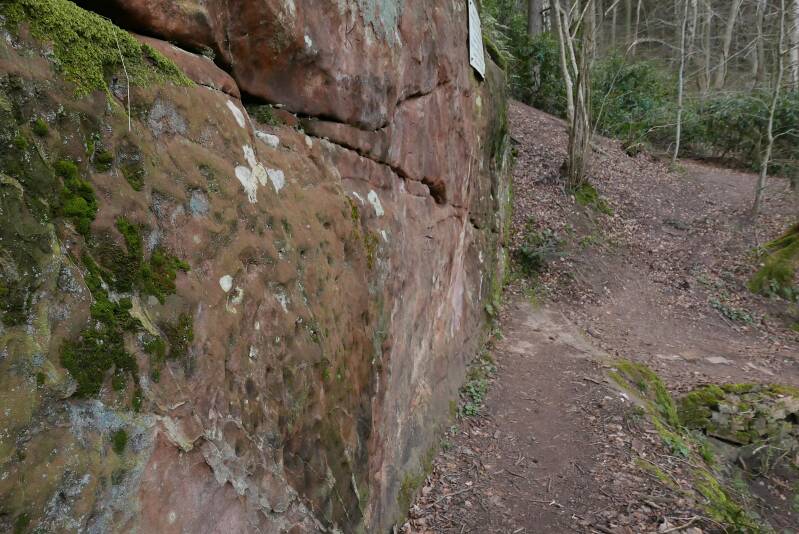
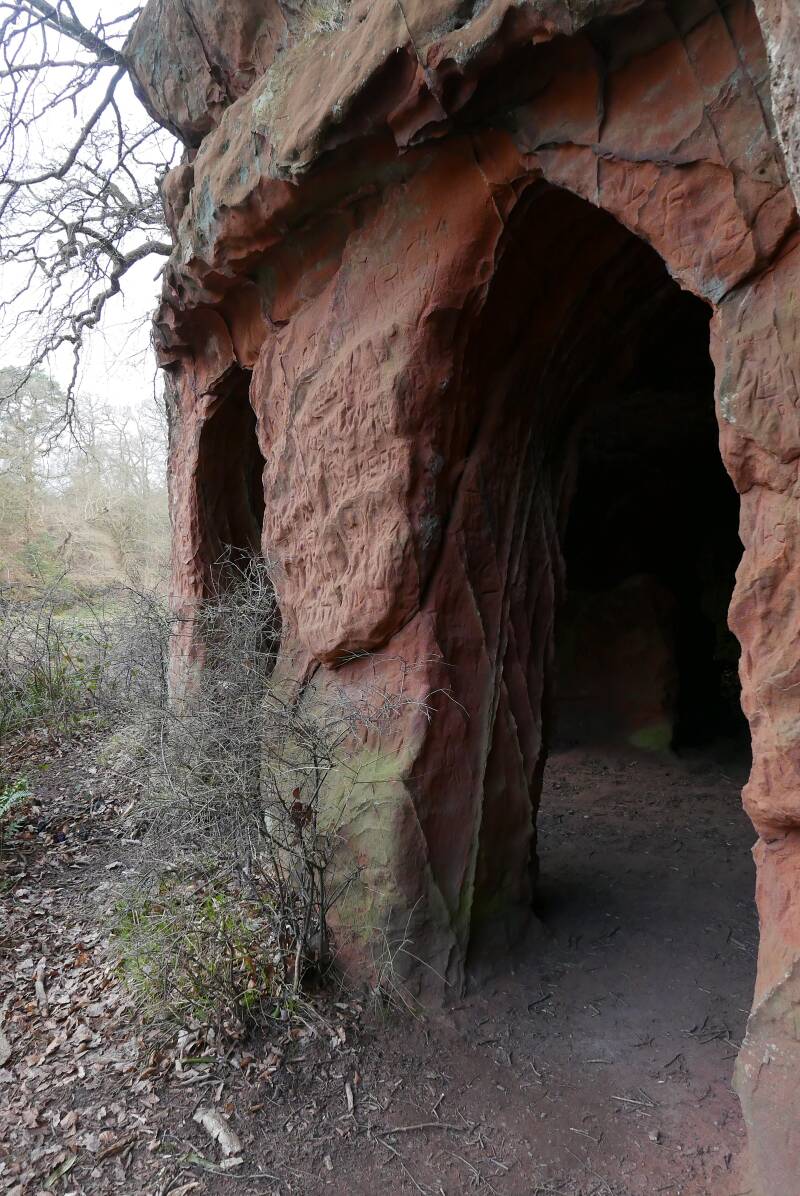
Photo below: two of the entrances to Lacey's Caves. Note again the similarity that these entrances have to the archways in churches, and the similarity between this site and Anchor Church in Derbyshire for example.
Lacey's Caves is a very interesting site, and can be considered as a part of the greater ancient area of the Eden Valley, which seems to have been extremely important in the past for different cultural groups, who I think interacted with the landscape in different ways, often during the same time periods.
There are also likely many more caves along this river and along the Eamont which have not been discovered yet. Furthermore, there are also caves similar to some others on the Eden which are carved into the sandstone cliffs of the River Gelt, which flows north of the Eden and then joins it before reaching Carlisle. I have discussed some of these other caves before briefly. Some of those on the Gelt appear to be located close to a Hayton Woods, which I learned from seeing Jonathan Adams' photo on geograph.org.uk which is titled NY5258 : Sandstone Cave in Hayton Woods, also giving the grid reference. A photo by David Browne also published on geograph.org.uk, titled NY7118 : Coupland caves also demonstrates another group of sandstone caves near Coupland, which I did not know about. The caves at Coupland appear similar to Lacey's Caves, at least in the entrances I can see, but those at Coupland look older and more degraded. This could in part make sense if for example Lacey's Caves were originally blocked off and more protected, and that in which case perhaps Colonel Lacey rediscovered them, and they were attributed to him.
I hope that this article was an interesting read. It is dedicated to the Great Good Spirit and to the ancestors of the Eden Valley.