89: The Megalithic Island of Cumbria, and on other nearby ancient sites
Written and published by Linden Alexander Pentecost, published on the 8th of January 2026. This publication was published in the UK like all of my publications, it is only published on this www.bookofdunbarra.co.uk website, and is unrelated to and separate from all of my other publications. No AI was used in this publication nor in any of my publications. Note that earlier today I made edits to an unrelated article/blog post also connected to the Eden Valley about Ull, but this is on a different website to this website you are on (www.bookofdunbarra.co.uk) and is unrelated to the article on this page, which covers an entirely different topic connected to the Eden region of Cumbria - namely the mysterious megalithic island at Wetheral in Cumbria, and comments on other nearby sites. I have also published many other unrelated publications concerning the giants, ancient history and linguistic history of the Lower Eden Valley in Cumbria. The four photos in this article were also taken by Linden Alexander Pentecost. This article contains a total of 1377 words and no sub sections, although different topics are discussed. The photos in this article have not been published before, the first two show the megalithic island, the second shows a megalithic rock near the island in the river, the fourth shows a stone at another nearby site with notch-indentations. The photo descriptions in this article contain a lot of important information not in the main text. This article also discusses some of the caves on the rivers Eden and Eamont, some of which I have discussed in different ways in other publications. Note I have also discussed other fascinating sandstone megalithic sites in several other articles on this website, and in addition to those aforementioned several articles, there is also article 78: on this website discusses spirit doors and sandstone in a sense (not one of the articles primarily about mainly sandstone sites though).
The Eden Valley in Cumbria was hugely important historically. We are talking about a place, which, today, seems very agricultural and in a sense sleepy, but which thousands of years ago, seems to have been one of the most important ritual landscapes in the whole of Britain. The Lower Eden Valley abounds in megalithic sites, cairns, stone circles, henges, legends, including lots of legends of giants, reports of ancient giant skeletons having been found, "thunderstones", stone rows, caves carved into sandstone (which in my opinion are older than what people say), and other mysterious sites. Whilst a lot of the sites in this valley are known, I have come across/discovered/noticed many potential archaeological sites which have not yet been officially identified.
One of the strangest, which I have discussed elsewhere briefly, is a megalithic island located on the River Eden near Wetheral. According to the vague historic reports, this island was built by the monks of a nearby abbey in order to create a salmon weir. The only problem with this theory is that creating a salmon weir doesn't generally require constructing an entire island out of megalithic blocks of stone, with the island being several hundred metres in length. To be precise, the island is just under 500 metres in length, so, big! The island does not rise far above the height of the river, but throughout its length, it is constructed of large slabs of sandstone. I personally find it very difficult to believe that the medieval monks at Wetheral Abbey would have needed to create a nigh-on 500 metre long island, made from megalithic blocks of sandstone, just to create a salmon weir. Even the people I have asked in Cumbrian museums were not able to provide any evidence that the island was created by monks, and when I have mentioned this site to them, they have sometimes agreed that it is indeed strange.
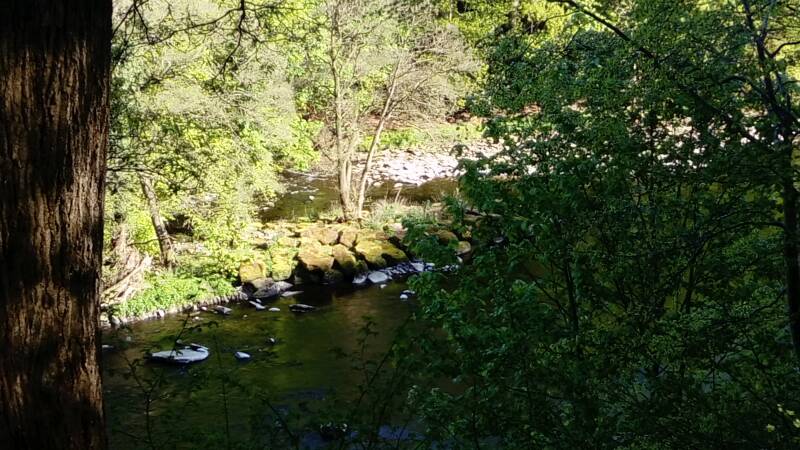
Photo below: a not-fantastic photo showing the end of the megalithic island near Wetheral, as taken from the footpath near St Constantine's Cells (one of the caves carved into the rock on this section of the River Eden). Note the large size of the sandstone blocks on a part of the island, roughly visible at the centre of the image.
You find that, many of the historic anomalies around the rivers Eden and Eamont are explained away, either as having been created by monks, or as having been created by local landowners. Another example of this phenomena is the caves carved into the sides of the rivers Eden and Eamont. One of these on the Eamont is associated with a giant, whilst the many more ornate caves carved into the riverside around Wetheral are again generally explained as having been created by monks, although, one does wonder, why monks on this river would have such urges to carve out so many small cells and rooms into the sandstone. One of these near Wetheral is public and open, known as St Constantine's Cells, but there are many other such caves along the same stretch of river, but on private land and which cannot be visited. There is also for example Lacey's Caves further up the River Eden, said to have been built by a local landowner. But for me, neither the monks, nor the local landowner at Lacey's Caves are good explanations for them. All of these caves have certain things in common, which to me, suggest that they are of earlier origin. Many of the caves are also examples of, or contain "spirit doors" or "dwarven doors" (see article 78: on this website for more details)
Photo below: a better image, showing a section of the megalithic island near Wetheral on the River Eden, this photo was taken from a small boat with the camera on a pole. Note the large size of the sandstone blocks used in the construction of the island, some of which are missing here. This photo also does not show the largest examples of these blocks as they occur on the island.
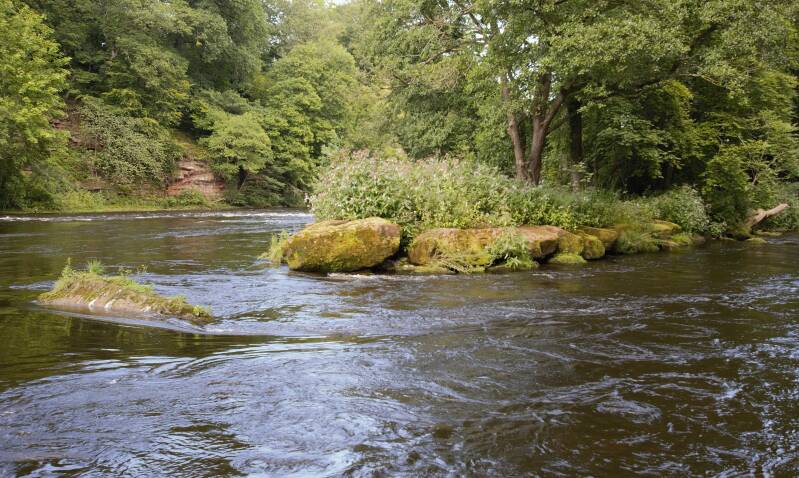
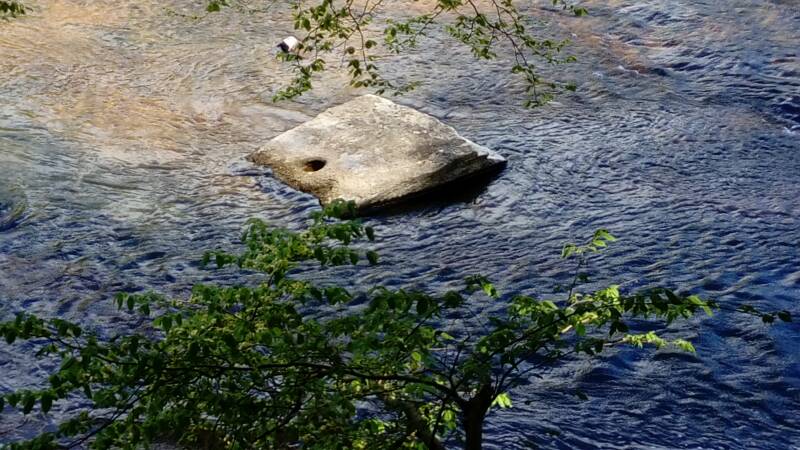
Photo below: an unusual sandstone block in the river close to the megalithic island. Note the large circular hole in the rock. St Constantine's Cells (around where this photo was taken from (note the cliffs to the river and footpath is dangerous) - St Constantine's Cells also contains these circular holes, and they are also seemingly common at sites where there are "spirit doors", (again, see article 78: on this website, and its discussions and photo of Amaru Muru in Peru).
I suspect that the megalithic island of Wetheral might indeed be connected to salmon in some way, with salmon being a very sacred fish and associated spirit animal and ancestor in ancient Britain, and in many other places. But I am not convinced that the site was built my monks. Personally, I am inclined to think that it is far older. Perhaps its purpose was also connected to energy, being somewhat akin to a "stone row", but rather an entire island of megalithic stones. Above the photo below is a photo description and discussion of yet another local megalithic site:
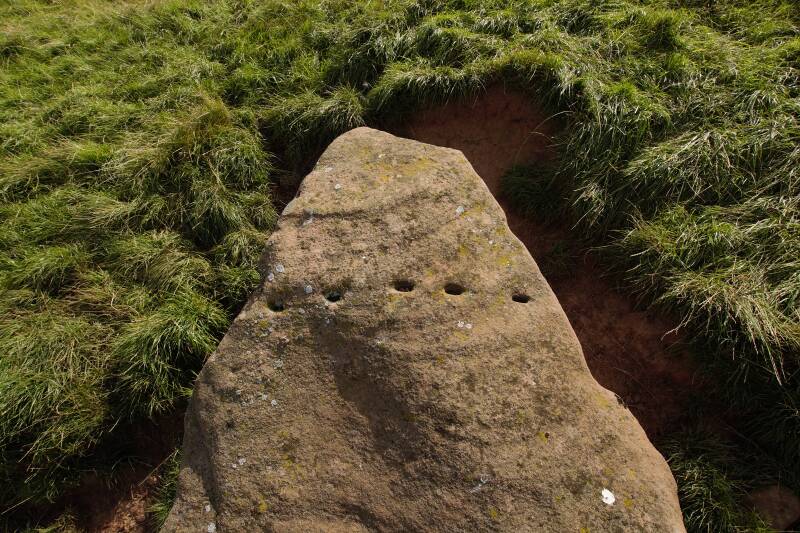
Photo below: a stone with a row of hole-marks in it, located at another mysterious megalithic site, of unknown name, not far from Wetheral. I noticed this site in a field on a footpath. Like many megalithic sites of uncertain form and description in the Eden Valley, this one is built around a natural spring, and likely in my opinion has to do with the flow of water and other energies. Notice the notch-like hole indentations on this stone (one of several stones at the site). The notch-like indentations are another example of the mysterious shapes (others being for example spirit doors, circular holes and square holes) found at ancient sandstone sites, many of which I have discussed elsewhere. The notch-like indentations on the stone in the photo below, are specifically similar to another example of these notches, found at the possible passage tomb on the top of Hunting Hill close to Carnforth and Warton in North Lancashire.
I hope that this article was an interesting read - it is dedicated to the ancients of the Eden Valley.